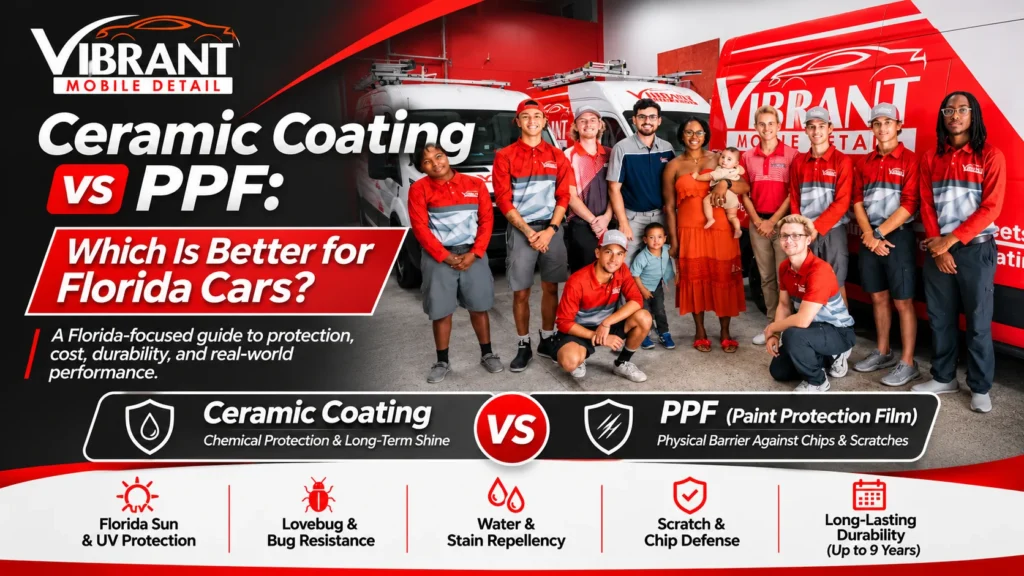
Ceramic coating vs PPF is the biggest paint protection decision most Florida drivers will ever make, and almost every guide online skips the part that matters most: what actually holds up in Florida sun, humidity, salt air, and lovebug season.
We work on vehicles every week at our Fort Myers shop and across Southwest Florida, and we see the results of both choices in the wild. Some hold up beautifully after five years. Some look terrible after three. The difference is rarely the product itself. It is the match between the product and the conditions it lives in.
This guide walks through both options honestly for anyone driving in Florida, whether you are in Miami, Tampa, Orlando, Jacksonville, Sarasota, or anywhere in the Southwest Florida corridor from Punta Gorda to Marco Island. What each option is, what it protects against, what it actually costs at professional installer pricing, how it ages in Florida conditions, and how to pick the right approach for the way you actually drive.
The Short Answer for Florida Drivers
For most Florida daily drivers, ceramic coating is the better choice. It delivers chemical resistance against the things that damage paint most often in this state, which are UV rays, lovebugs, tree sap, bird droppings, and rain fallout. It costs less than full-body PPF, lasts longer with proper care, and does not create the removal headaches that failed PPF can bring.
PPF still makes sense in specific scenarios. High-mileage highway commuters running I-75, I-95, the Florida Turnpike, or Alligator Alley regularly, exotic and collector vehicles where paint replacement is prohibitively expensive, and lease vehicles where surface protection matters at turn-in are all reasonable PPF candidates. In those cases, PPF on the front clip paired with ceramic coating over the whole vehicle is often the smart hybrid.
For snowbirds who bring a vehicle down for four to six months a year, ceramic coating is almost always the right call. The car spends most of its life outside Florida, and the ceramic layer handles the seasonal exposure without the cost or complexity of full PPF.
If you already have PPF that is failing, the section further down on what to do about it is worth reading before anything else.
What Ceramic Coating Actually Is
Ceramic coating is a liquid nano-ceramic that chemically bonds to your clear coat. Once it cures, it becomes a semi-permanent glass-like layer that behaves like part of the paint, not a topping sitting on top of it.
How the Chemistry Works
Professional ceramic coatings are silicon dioxide (SiO2) based formulas, sometimes reinforced with titanium dioxide or other nano-particles. When applied to properly prepared paint, the coating cross-links with the clear coat at a molecular level. It does not peel, wash off, or shift.
The result is a hard, hydrophobic surface. Water beads up dramatically and rolls off, carrying dirt with it. Contaminants sit on top of the coating instead of etching into the clear coat.
What Ceramic Coating Protects Against
Ceramic coating is built for the chemical and environmental hazards that damage paint most often in Florida:
- UV radiation, which causes clear coat oxidation and paint fading across the state
- Bird droppings, which are extremely acidic and etch unprotected paint within hours in Florida heat
- Bug guts and lovebug residue, which contain acids that eat into clear coat
- Tree sap, pollen, and pine needle stains
- Acid rain and industrial fallout
- Hard water spots from sprinklers and rain
- Light wash-induced swirl marks caused by micro-abrasion
The Crystal Serum Ultra ceramic coating we install carries a 9-year manufacturer warranty on painted surfaces when maintained properly. It also withstands surface temperatures up to roughly 485°F, which matters in a state where black paint on a July afternoon can hit 180°F or higher, whether you are parked in Miami Beach, Tampa, or Fort Myers.
What Ceramic Coating Does NOT Protect Against
This is the part that honest installers say out loud and marketing pages skip. Ceramic coating does not stop rock chips. It is a chemical shield, not a physical one. A pebble kicked up on I-75 will chip through ceramic coating exactly the way it would chip through bare clear coat.
If rock chip protection is your primary concern, ceramic coating is not the right tool. That is what PPF is for. Some owners solve this with a hybrid approach, which is covered later.
Crystal Serum Ultra and the 9-Year Warranty Benchmark
Not all ceramic coatings are equal. Consumer-grade ceramic sprays from retail stores contain low SiO2 concentrations and typically last a few weeks to a few months. Mid-tier installer coatings usually offer two to three year warranties. Professional-grade coatings like Crystal Serum Ultra by Gtechniq are in a different category entirely, with a 9-year warranty backed by the manufacturer when installed by an accredited installer and maintained on schedule.
Our shop is a Gtechniq accredited installer, which is required to purchase and warranty this product. If you are comparing quotes from different shops anywhere in Florida, ask specifically which product they use and what warranty comes with it. The answer separates real long-term protection from cheap ceramic sprays being sold as premium coatings.
What Paint Protection Film Actually Is
Paint protection film, often called PPF or clear bra, is a transparent urethane film applied over paint. It works completely differently from ceramic coating.
How TPU Film Works
PPF is made from thermoplastic polyurethane, a stretchy, durable material that can be heat-shaped to fit body panels. Skilled installers cut it to shape using patterns tailored to specific vehicle makes and models, then wrap and squeegee it onto the paint using a slip solution.
Once cured, the film sits on top of the paint as a sacrificial layer. When a rock hits your hood, the film absorbs the impact instead of the paint. Many modern PPFs also self-heal light surface scratches when exposed to heat, so small marks disappear over time.
What PPF Protects Against
PPF is built for physical hazards:
- Rock chips and gravel damage
- Road debris and grit spray from tires
- Bug splatter physical impact
- Light scuffs from door dings and shopping carts
- Sand and coastal grit
- Tar and asphalt splatter
If your primary paint concern is physical impact, PPF handles it better than anything else on the market.
What PPF Does NOT Protect Against
PPF is not chemically inert. It can still stain from bird droppings, especially if they sit for hours in Florida heat. The film itself can yellow from UV exposure over time. It does not provide the deep gloss enhancement that ceramic coating does. And it does not fix the maintenance burden of washing, since dirty PPF looks dingy the same way dirty paint does.
Coverage Options
PPF is usually installed in one of three coverage patterns:
- Partial front, covering the leading edge of the hood, front bumper, mirrors, and sometimes headlights. This is the entry-level PPF strategy for rock chip prevention on the parts of the vehicle that get hit most.
- Full front, extending the coverage to the entire hood, front fenders, front bumper, mirrors, and headlights.
- Full body, wrapping the entire painted surface. This is the most expensive option and where most PPF failures become visible over time in Florida sun.
For Florida daily drivers, if PPF makes sense at all it usually makes sense as partial front only, paired with ceramic coating over the rest of the vehicle.
Side-by-Side Comparison
| Feature | Ceramic Coating | Paint Protection Film |
| Protection type | Chemical (nano-ceramic shield) | Physical (urethane barrier) |
| Rock chip protection | No | Yes |
| Chemical etching resistance | Excellent | Limited |
| UV protection | Excellent | Good, degrades over time |
| Gloss enhancement | Significant depth and shine | Minor, may add subtle sheen |
| Lifespan in Florida | Up to 9 years on painted surfaces with maintenance | 5 to 7 years, often shorter in strong sun |
| Cost for midsize vehicle | $1,500 for Gold Ceramic, $2,200 for Platinum Ceramic | Roughly $800 to $1,500 partial front, $3,500 to $6,000+ full body (market estimate) |
| Maintenance | Inspection every 6 to 12 months recommended | Regular washing, edge inspection, possible reapplication |
| Removal difficulty | Not designed to be removed, wears down gradually | Can be complex, potential paint damage on aged film |
| Repairability | Panel re-coat if damaged | Panel re-film if damaged, higher cost |
How Florida Weather Changes the Math
Every generic ceramic coating vs PPF article assumes a moderate climate. Florida is not that. The specific hazards here shift the comparison in ways that most guides skip entirely, and this applies whether you drive in Miami, Fort Lauderdale, Tampa, Orlando, Fort Myers, or Naples.
What Florida Sun Does to PPF Vinyl
We regularly see PPF that looks great at the two-year mark start showing visible degradation at four to five years in Florida, especially on high-sun panels like the hood and roof. Common failure patterns include yellowing at the edges, lifting where the film meets body seams, bug etching that will not polish out, and a dinginess in the film itself that ceramic-coated panels simply do not develop at the same rate.
Interestingly, we have documented cases where a customer’s PPF-protected hood looked significantly worse after five years than the roof of the same vehicle, which had no protection at all. The film failed faster than bare clear coat did. That is not a knock on PPF as a category. It is a Florida-specific data point that most out-of-state comparison articles cannot make.
Lovebug Season and PPF Etching
Lovebug season hits Florida twice a year, in April and September. The acidic residue etches painted surfaces, and it etches PPF too. On paint protected by ceramic coating, lovebug residue typically wipes off with a light wash and quick detailer, because the hydrophobic ceramic surface will not let the acid bond deeply.
On PPF, the same residue can etch into the film itself. Once it does, polishing may reduce the visual mark but cannot fully remove damage from the film. Our lovebug season Florida removal guide covers the biology and the safe removal methods in more depth.
Humidity and Salt Air Impact on PPF Adhesive
The urethane film itself is stable, but the adhesive layer that bonds it to your paint is not fully immune to Florida’s coastal conditions. Constant humidity, temperature swings, and salt air push inland from both the Gulf and the Atlantic, especially in coastal cities like Miami, Tampa, St. Petersburg, Naples, Sarasota, and Jacksonville. This slowly degrades the adhesive, especially at panel edges. Edge lifting is one of the most common PPF failure modes we see in Florida.
Why Ceramic Coating’s Chemical Resistance Matters More in Florida
Florida vehicles face chemical hazards constantly. Bird droppings from beach-adjacent parking. Sap from banyan, palm, and pine. Sprinkler water with heavy mineral content. Salt-laden mist near both coasts. Ceramic coating’s whole design purpose is to shrug these off. That plays directly into the hazards Florida drivers actually face, most of the time, most days of the year.
Physical impact from rocks happens too, of course, but at lower frequency than the constant chemical assault. Matching the protection to the actual threat pattern is where ceramic wins for daily drivers throughout Florida.
What Florida Sun Does to Ceramic Coating
To be fair, ceramic coating is not invincible in Florida either. Standard consumer ceramic sprays can degrade in as little as three to six months here. Even mid-tier professional coatings often lose their hydrophobic performance in year two or three, though they continue to offer chemical protection.
This is why product choice matters so much. Crystal Serum Ultra is engineered for exactly this environment. Its ~485°F thermal tolerance and hardness rating hold up in Florida sun where lighter formulas struggle. Wax by comparison melts and slides at surface temperatures around 120°F, which any Florida hood exceeds routinely. That is why we do not recommend wax as a long-term protection strategy for Florida drivers.
The True Cost Over 5 Years
Sticker price comparisons are misleading because ceramic coating and PPF have very different lifespan economics. The honest way to compare is cost per protected year, using real installer pricing.
Ceramic Coating Cost Over 5 Years
Real pricing at our shop for the Gold Ceramic Coating package with Crystal Serum Ultra installation:
- Small vehicle (2/4 door car): $1,400
- Midsize vehicle (2-row SUV or 2-door truck): $1,500
- Large vehicle (3-row SUV, 4-door truck, or van): $1,600
The Platinum Ceramic Coating package with ceramic on all glass, plastic and rubber trim, wheels off application including brake calipers, interior leather, fabric, and dashboard ceramics:
- Small vehicle: $2,100
- Midsize vehicle: $2,200
- Large vehicle: $2,300
Both packages carry a 9-year product warranty from Gtechniq and Vibrant. Ceramic maintenance inspections are recommended every 6 to 12 months to keep the coating performing at its best and to maintain warranty coverage.
For a midsize daily driver, a single Gold Ceramic install at $1,500 plus periodic maintenance visits over 5 years typically totals in the $2,500 to $3,500 range depending on how often you schedule maintenance and whether you add ceramic top-coats during those visits. That works out to roughly $500 to $700 per protected year for continuous, warrantied protection.
PPF Cost Over 5 Years
We do not install PPF at Vibrant Mobile Detail, so these figures are market averages from Florida installers rather than our own pricing. A partial front PPF install on a midsize vehicle typically runs $800 to $1,500. Full front is usually $1,500 to $3,000. Full body PPF for a midsize vehicle runs $4,000 to $6,000, and for larger vehicles or exotics can exceed $8,000 to $10,000.
Full body PPF in Florida often needs partial reapplication or repair at the 4 to 5 year mark due to the sun exposure issues covered above. Removal and reapplication of a full body wrap can push total 5-year cost past $10,000 for a midsize vehicle, or roughly $2,000+ per protected year.
The Hidden Cost: PPF Removal and Paint Damage Risk
This is the part that surprises most owners. Aged PPF is significantly harder to remove than fresh PPF. As the film cures on your vehicle for years in Florida sun, the adhesive becomes brittle and the film loses its stretch. Skilled removal by an experienced installer is essential to avoid pulling clear coat with the film.
If removal does damage the paint, repair costs can range from a few hundred dollars for a small area of touch-up work to a few thousand dollars for panel repaint. This is a real risk factor that should be counted in the total cost analysis, especially for older PPF installs on vehicles that have spent multiple summers in Florida sun.
What Insurance and Resale Value Actually Reflect
Insurance companies do not typically discount for either ceramic coating or PPF. Both are considered cosmetic add-ons rather than structural protection. On resale value, well-maintained ceramic coating and clean PPF both help preserve appearance and modestly support resale price. Failed or ugly PPF actively hurts resale value, sometimes significantly, because the removal cost becomes the buyer’s problem.
Real-World Failure: What Failed PPF Looks Like After 5 Years
We recently had a customer bring in a 2021 truck with a full front PPF that had been installed shortly after purchase. The truck was five years old. On paper, this should have been well within the film’s expected lifespan.
The reality was different. The front end showed severe bug etching that had permanently marked the film. The clear coat under the PPF looked perfect, but the film itself had degraded to the point where compounding barely helped. The vehicle’s roof, which had no PPF, actually looked significantly better than the PPF-protected hood.
The original PPF install had cost around $3,500. Removal of the aged film risked damaging the paint underneath. Reinstallation would be another $3,500 or more. Total cost of the PPF strategy for that owner was heading toward $7,000 over 5 years, and the visual result on the front end was worse than the untreated roof.
The alternative would have been a Crystal Serum Ultra Gold Ceramic Coating at $1,500, plus a couple of maintenance visits, plus professional touch-up on any rock chips that appeared over 5 years. Total cost would have been under $3,500 including chip repairs, the coating would still have several years of warranty coverage, and the front end would have looked at least as good as the roof.
This is not an argument against PPF as a category. It is an argument that PPF in Florida requires realistic expectations about lifespan and honest math about total cost. If your budget only allows one strategy, and you drive daily anywhere in Florida, ceramic is usually the smarter allocation.
When PPF Actually Makes Sense in Florida
PPF is not a bad product. It is a specialized tool that solves specific problems very well. Here are the Florida use cases where it makes clear sense.
High-Mileage Highway Commuters
If your daily commute includes long stretches of I-75, I-95, the Florida Turnpike, Alligator Alley, US-41, or the interstates connecting Florida’s major cities, you are taking constant rock strike risk. High-mileage drivers who log 20,000+ miles annually and spend most of it on highway benefit from PPF on the front bumper and hood leading edges. The rock chip protection is worth the investment, and highway-heavy vehicles typically spend less time baking in stationary sun than commuter cars that park outside all day.
Exotic and Collector Vehicles
For a Porsche, Ferrari, Lamborghini, or any exotic where paint refinishing costs $5,000+ per panel, PPF is often the right protective investment even at a premium cost. These vehicles typically live in garages when not in use, which extends PPF lifespan significantly. They also see lower annual mileage than daily drivers, spreading the film’s useful life over more calendar years.
The Front-Clip-Only Strategy
Our most common recommendation for Florida owners who want physical rock chip protection is a partial front PPF covering just the leading edge of the hood, the front bumper, and mirrors, paired with full ceramic coating over the entire vehicle. This gives you the best of both worlds: chip protection where chips actually happen, chemical protection everywhere else, and a much lower total cost than full body PPF.
The critical detail is that the ceramic coating goes on top of the PPF, not underneath it. Ceramic can be applied over cured PPF without issues, and this actually helps preserve the film by adding a hydrophobic layer that makes cleaning easier and reduces contaminant bonding.
Lease Vehicles and Resale-Focused Owners
If you lease and plan to turn the vehicle in at the end of the term, PPF that protects against physical damage during your lease period can pay for itself in avoided damage charges. Similarly, if you plan to sell within a few years and want to protect appearance for resale, PPF makes sense in that timeframe before long-term Florida degradation becomes an issue.
Can You Combine Ceramic Coating and PPF?
Yes, and for many enthusiasts this is the ideal setup. But the order matters, and combining them adds cost that should be considered against the value.
Ceramic Over PPF: The Premium Hybrid
This is the correct order. PPF is installed first over freshly detailed and decontaminated paint. Once the film has cured for a few days, ceramic coating is applied over both the PPF and the surrounding painted panels. The result is one continuous hydrophobic layer over the entire vehicle. Water beads uniformly. Cleaning is easier. The PPF itself benefits from the ceramic layer, since dirt and contaminants have a harder time bonding to the film.
PPF Over Ceramic: Why This Order Does Not Work
If ceramic coating is applied first and then PPF is installed over it, the film has bonding problems. Ceramic coating is designed to be extremely low-friction and hydrophobic. That same property prevents PPF adhesive from bonding properly to the coated surface. Any installer who suggests this order should be a red flag. The film will lift, peel, or fail prematurely.
Cost Expectations for the Combined Approach
Partial front PPF from a reputable Florida installer plus our Gold Ceramic Coating on a midsize vehicle typically totals $2,300 to $3,000. Partial front PPF plus Platinum Ceramic Coating pushes to $3,000 to $3,700. Full body PPF plus ceramic can easily exceed $6,000 to $8,000. For most Florida daily drivers, partial front PPF plus Gold or Platinum Ceramic Coating is the sweet spot of the combined approach.
How to Decide: A Framework for Florida Vehicle Owners
Rather than a generic recommendation, here is the decision framework we use with customers.
If You Drive a Daily Commuter Under 15,000 Miles Per Year
Go with professional ceramic coating as your primary strategy. The chemical hazards of Florida daily driving are your biggest paint threat, and ceramic handles those better than PPF. Skip PPF entirely unless you have specific concerns about a stretch of your commute that produces regular rock strikes.
If You Own a Luxury or Exotic Weekend Vehicle
Consider full body PPF from a reputable Florida installer if the paint is truly irreplaceable or extremely expensive to refinish. Layer ceramic coating on top for gloss enhancement and easier cleaning. Store the vehicle in a garage or covered structure whenever possible to maximize PPF lifespan. This is the highest cost approach but the right one for vehicles where paint value justifies it.
If You Are a Snowbird With the Car in FL Only 4-6 Months
Go ceramic coating. The car spends most of its life in a milder climate, and the Florida seasonal exposure will not push ceramic to its limits during your time in state. PPF is usually overkill for this use case unless you already have it from your primary market.
If You Have Failing PPF Right Now, What to Do Next
Do not panic and do not attempt DIY removal. Bring the vehicle in for evaluation. In many cases, professional removal is possible without paint damage if done carefully. Depending on the film’s condition and the paint underneath, we can then apply Crystal Serum Ultra ceramic coating with appropriate paint correction to restore appearance and protect the vehicle going forward. In some cases where PPF removal risks paint damage, refinishing may be recommended before ceramic application. The right answer depends on the specific vehicle.
What to Look for in a Florida Installer
Whether you choose ceramic coating, PPF, or a hybrid, the installer matters as much as the product. Here is what to check anywhere in Florida.
Manufacturer Certification
Reputable ceramic coatings like Crystal Serum Ultra require accredited installer status to purchase and warranty the product. If a shop cannot show manufacturer accreditation for the coating they are installing, they may be using a lower-grade product marketed under a similar name. Our shop’s Gtechniq accreditation is one of the reasons we can offer the 9-year warranty.
For PPF, look for installer certification with major brands and physical evidence of past work on vehicles similar to yours.
Shop Climate Control for Coating Application
Ceramic coating cures best in a controlled environment with steady temperature, low humidity relative to ambient, and no wind or dust. Our climate-controlled bays are set up specifically for this. Coatings applied outside on humid Florida days can develop application flaws that reduce lifespan and performance. Ask where the coating will be applied and whether curing conditions are controlled.
Warranty Transparency
Ask for the warranty document in writing before booking. Understand what the warranty covers, what voids it, and what the maintenance requirements are to keep it valid. A shop that hands you a real manufacturer warranty backed by a global brand is a very different proposition from one that offers a vague in-house warranty.
Prep Quality: Why Paint Correction Matters Before Either Service
The single biggest predictor of long-term ceramic or PPF performance is the condition of the paint underneath. Swirl marks, oxidation, and contamination will be locked in permanently once ceramic coats over them, and PPF will faithfully reproduce every imperfection through the clear film. Any reputable installer will discuss whether professional paint correction is needed before applying either protection product. Skipping this step to save money almost always costs more in the long run.
Frequently Asked Questions
Does ceramic coating protect against rock chips?
No. Ceramic coating is a chemical shield, not a physical barrier. Rock chips will still occur through ceramic coating. If rock chip protection is your primary concern, PPF is the right tool. For most Florida daily drivers, the ceramic coating’s chemical resistance is worth the trade-off because chemical damage is more common than rock strikes in this environment.
How long does PPF last in Florida sun?
Manufacturer ratings often list 10 years, but real-world Florida performance is typically 5 to 7 years on high-sun panels like hoods and roofs. Vehicles that live in garages between drives can approach the 10-year mark. Vehicles parked outside daily often show visible degradation at 4 to 5 years. Bug etching, edge lifting, and yellowing are the most common failure modes we see.
Is PPF or ceramic coating better for a Tesla or EV?
Same rules apply as gas vehicles. If the vehicle is a daily driver in Florida, ceramic coating is usually the better choice. If it is a garage-kept enthusiast vehicle or you drive highway miles regularly, hybrid ceramic plus partial front PPF is a strong option. EVs do not require any special handling that changes the decision framework.
Can I apply ceramic coating myself at home?
Consumer ceramic sprays are available and can be applied at home, but they are not comparable to professional coatings in longevity or protection. True professional coatings like Crystal Serum Ultra require accredited installer status to purchase, controlled application environments, and proper paint preparation for the warranty to be valid. If long-term protection is the goal, professional install is worth the investment.
How much does ceramic coating cost in Florida?
Our Gold Ceramic Coating starts at $1,400 for a small vehicle, $1,500 for midsize, and $1,600 for large vehicles, with Crystal Serum Ultra installation and a 9-year warranty. Platinum Ceramic Coating with ceramic protection on glass, wheels, plastics, and interior surfaces runs $2,100 to $2,300 depending on vehicle size. Prices at other Florida shops vary widely depending on product quality and warranty terms.
Will PPF damage my paint when it is removed?
Fresh PPF removed within its intended lifespan generally comes off cleanly. Aged PPF in Florida, especially film that has been on the vehicle for 5+ years, carries meaningful risk of paint damage during removal because the adhesive becomes brittle and the film can lift clear coat with it. Professional removal reduces the risk but does not eliminate it. This is one reason PPF requires realistic Florida lifespan planning.
Do you install PPF at Vibrant Mobile Detail?
No, we do not offer PPF as a service. We focus exclusively on ceramic coating with Crystal Serum Ultra, paint correction, and traditional detailing services because we believe those deliver the best outcomes for the majority of Florida daily drivers. If PPF is the right choice for your specific vehicle and use case, we can help you understand what to look for in a reputable PPF installer, and we are happy to apply ceramic coating on top of an existing PPF install to give you the benefits of both protection strategies.
The Verdict for Florida
For most Florida drivers, ceramic coating is the smarter choice. It handles the chemical hazards that damage paint most often in this environment. It costs less than PPF over the vehicle’s useful life at $1,400 to $2,300 for full professional installation. It carries the longest warranty in the paint protection space at 9 years when installed properly. And it does not create the removal and reapplication cycle that PPF often triggers after four to five years in Florida sun.
PPF still has a place, particularly for high-mileage highway commuters, exotic and collector vehicles, and the partial-front hybrid strategy paired with ceramic. But it is a specialized tool for specialized problems, not a default choice for every Florida vehicle.
If you are trying to decide for your specific vehicle, our team at Vibrant Mobile Detail can walk you through the options honestly, including whether PPF from another installer might be worth pairing with our ceramic coating service. Our mobile detailing service currently covers the Southwest Florida corridor from Punta Gorda down to Marco Island, including Fort Myers, Cape Coral, Naples, Bonita Springs, and Estero, with our shop in Fort Myers open to owners across the state who want climate-controlled ceramic coating installation. When you are ready to protect your vehicle for the long haul in this climate, book a ceramic coating consultation and we will build the right plan for how you actually drive.