Car detailing is one of the few $10 billion service industries in the United States with almost no regulatory oversight. There is no state licensing requirement in Florida. There is no mandatory training. There is no continuing education, no insurance mandate specific to the trade, and no consumer protection framework beyond general small claims court. Anyone with a bucket, a bottle of soap, and a Craigslist ad can call themselves a professional mobile detailer tomorrow morning.
This regulatory vacuum is why choosing a detailer matters so much more than choosing most other automotive services. When you take your car to a mechanic, the state licenses the technician. When you take your car to a body shop, the insurance company has already vetted the operation. When you book a detail, you are relying entirely on your own ability to evaluate the operation before they touch your paint.
The problem is that most Florida drivers evaluate detailers the way they evaluate restaurants: star ratings, photos, and a quick scan of recent reviews. That works for restaurants because restaurants are mostly interchangeable and the downside of a bad meal is one bad meal. Detailing is different. A bad detailer with wrong wash technique can install permanent swirl marks in your clear coat in a single appointment. A bad ceramic coating installer can lock defects into your paint under a warranty that fails within a year. The downside of choosing wrong compounds over time.
This guide walks through what actually separates professional detailing operations from budget shops that look similar in Google Ads. Every criterion below is what we would verify if we were the customer, based on how the detailing industry actually operates behind the scenes. This is written to be useful whether you eventually book us or not.
The Reality of the Detailing Industry
Before the checklist, some industry context that changes how you evaluate detailers.
Florida has thousands of registered mobile detailing operations. Most of them are one-person or two-person operations with minimal equipment, minimal insurance, and minimal training. The barrier to entry is low. A $2,000 Craigslist van with a $500 pressure washer and some bottles of car wash soap gets someone into the market. Whether they belong there is a different question.
The most sophisticated professional operations are small businesses with genuine investment in equipment, training, certification, and insurance. There is no scale advantage to detailing the way there is to fast food or big-box retail. A well-run three-person shop can deliver identical or better quality than a 20-person shop, because detailing is a craft skill that does not benefit from mass production.
The result is a market where the visible signals (marketing, ads, review counts) are only weakly correlated with actual quality. A slick website means someone paid a marketer. A high review count means the operation has been around long enough to accumulate reviews. Neither is a reliable indicator of what happens when the technicians actually touch your car.
The reliable indicators are technical. They require you to ask specific questions and evaluate specific answers. Here are the ones that matter, in the order they tell you the most.
Indicator 1: Deionized Water on Every Wash
This is the fastest quality signal in the industry. Professional operations use deionized water for the final rinse on every service. Budget operations use tap water because DI water systems cost money to operate.
Florida tap water is exceptionally hard. Municipal water in Fort Myers, Naples, and most of the Southwest Florida corridor runs 200 to 250 ppm total dissolved solids. Miami runs 219 ppm. West Palm Beach hits 317 ppm. When any of that water is used to rinse a vehicle and dries in Florida sun, mineral deposits form as visible white spots and, over time, etch into the clear coat.
Deionized water reads 0 ppm and evaporates cleanly. Every professional Vibrant Mobile Detail service uses onboard DI water measured with a TDS meter to verify 0 ppm on the final rinse. This is the technical baseline, not a premium upsell.
How to verify: Ask “Do you use deionized water for the final rinse on every service, and can you show me a TDS meter reading?” A professional operation answers yes without hesitation and can demonstrate the meter. A budget operation either does not know what a TDS meter is, or says DI water is available “for premium services” (translation: it costs extra and is not standard).
Our full technical breakdown on why deionized water matters in Florida detailing covers the chemistry and gives you the specific city-by-city water hardness data.
Indicator 2: Manufacturer-Verified Ceramic Coating Certification
If you are considering ceramic coating, this indicator matters more than any other. Ceramic coating quality is 20 percent product and 80 percent installer. The best product in the world installed poorly will fail. A mediocre product installed by a certified professional will outperform expectations.
Real professional ceramic coatings are only sold to accredited installers who have completed manufacturer training. The specific products worth knowing about:
- Gtechniq Crystal Serum Ultra: Requires Gtechniq accreditation. 9-year warranty on painted surfaces when installed by accredited installer. This is what we install at Vibrant Mobile Detail.
- Ceramic Pro: Requires Ceramic Pro certification. Multiple product tiers with different warranty terms.
- System X: Requires System X certification. Warranty terms vary by tier.
- CQuartz Professional (CarPro): Requires CarPro authorized installer status.
Any shop that cannot show manufacturer accreditation for the coating they are quoting you is either misrepresenting the product or using a lower-grade retail product marketed under a similar-sounding name. This happens frequently because “ceramic coating” as a term is not trademarked. Any shop can call any silica-based spray a “ceramic coating” whether it lasts 3 months or 9 years.
How to verify: Ask the shop for their accreditation certificate. Then look up the installer directly on the manufacturer’s website. Gtechniq maintains a public directory of accredited installers at their global site. Ceramic Pro, System X, and CarPro maintain similar directories. If the shop’s name does not appear in the manufacturer’s directory, the accreditation claim is either lapsed or fabricated.
Second verification: Ask what the warranty document looks like. A real manufacturer warranty is a printed or PDF document from the manufacturer, not the shop. It lists specific coverage terms, exclusions, and maintenance requirements. If the shop hands you a warranty on their own letterhead with no reference to the manufacturer’s official warranty document, the warranty is only as good as the shop’s ability to honor it directly.
The ceramic coating packages we install come with the Gtechniq global warranty, which transfers if you sell the vehicle. Shop-only warranties often do not transfer and are worthless the moment the shop closes or changes ownership.
Indicator 3: Real Insurance With a COI You Can Verify
Mobile detailers work on your property with equipment that can damage your vehicle, damage your property, or cause injury. Shop detailers move your vehicle around a facility with tools that can drop, slip, or fail. Insurance protects both parties when something goes wrong.
The insurance a real detailing operation carries typically includes:
- General liability insurance ($1M to $2M coverage typical) protecting against property damage and bodily injury claims
- Workers compensation insurance covering technician injuries (required in Florida for operations with 4+ employees)
- Commercial auto insurance covering the mobile van and any customer vehicles being moved
- Business personal property coverage protecting the operation’s own equipment
- Optional: Inland marine coverage for tools and equipment stored off-site
- Optional: Garage keepers coverage for shop operations where customer vehicles are on-site
How to verify: Ask for a Certificate of Insurance (COI). Any legitimate business can produce one within 24 hours from their insurance broker. The COI names the insurance carrier, policy numbers, coverage limits, and effective dates. You can call the insurance broker directly to verify the COI is current.
What a fake or inadequate COI looks like: A COI that lists only “liability” without specific coverage limits. A COI where the effective date has expired. A COI from an insurance broker whose phone number does not answer. A refusal to provide a COI on the grounds that “we do not carry insurance because we are that careful.” No professional operation makes this argument.
Why this matters practically: If a pressure washer nozzle chips your paint during a mobile detail, an insured operation files a claim and the insurance company covers repair costs. An uninsured operation either denies the damage occurred, disappears, or offers a small cash settlement that does not cover actual repair. If a technician slips and injures themselves on your property, an insured operation’s workers compensation covers medical costs. An uninsured operation could lead to their personal injury attorney contacting your homeowner’s insurance.
Indicator 4: Transparent Published Pricing
Professional operations publish their pricing. Prices are itemized by service tier and vehicle size. Add-ons are listed with specific costs. Taxes are included in the price you see. There is no “starting at” language that bears no relationship to what you actually pay.
At Vibrant Mobile Detail, our full pricing is on the website:
- Bronze Clean: $200 (small) / $220 (midsize) / $240 (large)
- Silver Shine: $240 / $260 / $280
- Gold Detail: $340 / $370 / $400
- Platinum Detail: $410 / $450 / $490
- Complete Interior Detail: $230 / $250 / $270
- Complete Exterior Detail: $210 / $230 / $250
- Gold Ceramic Coating: $1,400 / $1,500 / $1,600
- Platinum Ceramic Coating: $2,100 / $2,200 / $2,300
- Add-ons individually listed: Engine Detail $50, Headlight Restoration $120, Pet Hair Removal $60, Smart Glass Ceramic $175, Ceramic Rinse-On $50, Odor Elimination $45, Extraction $40 per seat or $100 per carpet, Undercarriage Clean $20, Child Seat $45
You know the price before booking. You pay that price at completion. If the vehicle is in worse condition than the standard package handles (heavy pet hair, extreme interior damage, oxidation requiring correction), the technician discusses upgrades on-site before proceeding. There are no surprise fees.
What to watch for: Detailers who refuse to give a price until they see the vehicle in person for what should be a standard service. Detailers whose “starting at” prices are 20 to 40 percent below what you actually pay. Detailers who add mandatory fees at completion that were not disclosed at booking. Detailers who upsell aggressively on-site to double or triple the original quote.
Indicator 5: Reviews With Substance, Not Just Star Counts
Star ratings alone are close to useless. Any operation can generate 100 five-star reviews through friends, family, incentive programs, or review manipulation services. What separates genuine reviews from noise is substance.
What genuine reviews look like:
- Mention specific package names (“The Gold Detail was excellent”)
- Mention specific staff members by name
- Describe specific outcomes (“Removed the pet hair I thought was permanent”)
- Include photos of the actual vehicle and work
- Include some criticism or specific comparison (“Better than [other shop] I tried previously”)
- Come from accounts with review histories showing other legitimate business reviews
What fake or incentivized reviews look like:
- Generic praise without specifics (“Great service, highly recommend”)
- Reviews clustered in specific time windows (100 reviews in two weeks)
- Reviews from accounts with no other reviews
- Identical or near-identical wording across multiple reviews
- No negative reviews at all across hundreds of reviews (statistically nearly impossible for any real business)
- Reviews that never mention the actual work in specific terms
How to spot the difference: Read 20 to 30 recent reviews carefully. Look at reviewer profiles. Check if the shop responds to reviews thoughtfully or with copy-paste replies. Cross-reference reviews across Google, Yelp, and Facebook to see if patterns are consistent or if one platform has a suspicious cluster.
Our own numbers, as a specific reference: Vibrant Mobile Detail has 5-Star rated Google reviews. We do have some four-star and negative reviews scattered through the history because no operation is perfect and no operation with hundreds of real reviews has a perfect zero-negative record. Our team responds to every review, positive or negative, with specific responses referencing the specific service. Compare this pattern against other Florida detailers you are considering.
Indicator 6: The Actual Equipment on Their Mobile Van
For mobile detailing services, the van setup tells you everything. A properly equipped professional mobile detailing van carries:
- Water systems: Onboard deionized water tanks (typically 30 to 100 gallons), water pumps, and pressure washing equipment. Not dependent on your outdoor spigot.
- Power systems: Onboard generator (typically 3,500 to 7,000 watts) or high-capacity inverter running off van battery/alternator. Not dependent on your outdoor outlet.
- Machine polishers: Multiple dual-action polishers (typically Rupes, Flex, or Griot’s Garage), and rotary polishers for more aggressive correction work. Not just one polisher for every job.
- Extraction equipment: Hot water extractor (Bissell, Mytee, or similar commercial units) for deep interior cleaning on Superior packages.
- Vacuums: Commercial wet/dry vacuums, not consumer models from Home Depot.
- Compressed air: Air compressor for detailing tight spaces the vacuum cannot reach.
- Product inventory: Full range of professional-grade soaps, ceramic coatings, waxes, polishes, compounds, interior cleaners, dressings, and specialty products. Not just three bottles from the auto parts store.
- Microfiber inventory: Multiple grades of microfiber towels dedicated to specific tasks. Different colors for wash mitts, drying towels, buffing towels, interior towels, glass towels. Contamination never crosses between surfaces.
- Lighting: Portable LED work lights for defect inspection.
- Climate management: Awnings or shelters for weather-sensitive work.
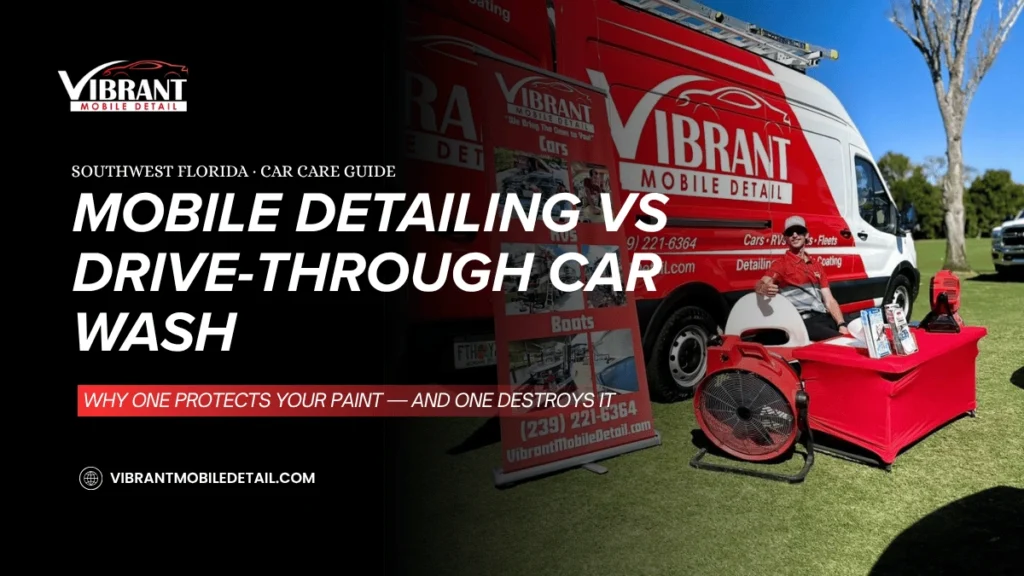
Our Vibrant Mobile Detail mobile setup is built into fully equipped high-roof cargo vans that carry all of the above. This is what allows mobile detailing to deliver identical results to shop-based detailing for most services.
What to ask for: Ask the operation to describe their van setup. A real professional operation talks about their equipment comfortably because they invested in it. A low-tier setup gives vague answers or admits they use the customer’s water and power.
Warning sign: If a “mobile detailer” arrives in a passenger car, a small SUV, or a hatchback with a bucket in the trunk and a garden hose adapter, they are not a professional operation. The physical size of the equipment required for real professional detailing does not fit in a passenger vehicle.
Indicator 7: Clean and Organized Workspace
Shops and vans get judged the same way you would judge any professional operation: are things organized, or is everything in disarray?
A professional detailing shop has:
- Clear work bays with room around the vehicle
- Dedicated microfiber towels sorted by task and color
- Categorized products stored in labeled shelving
- Clean tools maintained between uses
- Adequate lighting (multiple overhead LED fixtures for defect visibility)
- Climate control (temperature and humidity)
- Ventilation for chemicals and compounds
- Clean floors that get swept and mopped regularly
A professional mobile setup has the equivalent in a smaller footprint. Organized product storage on shelving, dedicated towel bins by task, categorized tool storage, visible cleanliness.
Why this matters technically: Cross-contamination is one of the biggest sources of preventable damage in detailing. A wash mitt dropped on the floor picks up grit that then scratches the paint. A microfiber towel used on wheels then used on paint transfers brake dust particles that swirl the clear coat. A polishing pad contaminated with previous compound cross-contaminates the next vehicle’s paint. Every one of these mistakes is preventable with organized workspace habits.
How to evaluate: For shops, ask to see the work area during your first booking. Legitimate shops are proud of their workspace. For mobile services, watch the setup as the van arrives. Check if towels come out of organized bins or from a pile in the back of the van. Check if products are categorized or jumbled together.
Indicator 8: Team Training and Never-Solo Practice
Detailing is a craft skill that takes years to develop properly. A shop’s approach to training new technicians tells you what quality you can expect on any given job.
Professional practice: New technicians are paired with experienced detailers on every job for their first 3 to 6 months minimum. They observe first, then perform under supervision, then perform with an experienced technician on the same job. A new technician never works alone until they have proven their skills across the full range of services the operation offers.
Budget practice: New technicians are sent solo on jobs within days of hire. Their training is “here is what to do, go do it.” Mistakes get discovered by customers, not by supervising staff.
At Vibrant Mobile Detail, our newer technicians never work alone. Every mobile appointment has an experienced detailer present, which is why our results are consistent across the team. This is also why our team size grows slowly. We add technicians only when we have the capacity to train them properly, not when demand spikes.
How to verify: Ask directly. “How many technicians will be on my job, and will an experienced technician be part of the team?” The answer tells you both the staffing plan for your specific job and the operation’s general training philosophy.
Indicator 9: Realistic Promises, Not Miracles
The clearest sign of an inexperienced or dishonest detailer is over-promising. Real professionals set realistic expectations because they know what services can and cannot accomplish. Amateurs and salespeople make claims that sound too good to be true.
Common miracle promises that expose weak operations:
“We can remove all scratches from your paint.”
Reality: deep scratches that go through the clear coat cannot be safely polished out because polishing only removes clear coat thickness. Deep scratches need paint repair or refinishing.
“This ceramic coating never needs maintenance.”
Reality: all coatings need periodic maintenance inspections. Crystal Serum Ultra has a 9-year warranty conditional on maintenance every 6 to 12 months.
“One detail will fix years of neglect.”
Reality: heavily contaminated paint often requires multi-stage correction across multiple sessions. Interiors with years of embedded contamination require extraction and often multiple treatments to fully address.
“Same-day ceramic coating installation.”
Reality: professional ceramic coating requires 12 to 24 hours of controlled curing after application. Anyone promising true same-day results is either using inferior products or cutting the curing period.
“Our detail restores paint to showroom condition.”
Reality: showroom condition after years of use requires paint correction and, often, refinishing on specific panels. A single detail restores what the current paint state allows.
“Zero swirl marks guaranteed after our service.”
Reality: professional detailing minimizes swirl mark induction and can polish existing swirls, but the physics of wash contact means some level of swirl induction is inherent to any wash process, even the safest.
“Our ceramic coating is harder than diamond” (or “9H hardness” claimed as diamond-hard).
Reality: the “9H” rating in ceramic coating marketing refers to pencil hardness scale, which tops out at 9H. It does not mean the same thing as Mohs hardness where diamond is 10. Actual ceramic coating hardness is somewhere between glass and steel, not diamond.
What professionals actually say: Real detailers explain what a service can accomplish, what it cannot accomplish, what the trade-offs are, and what alternatives exist. They are willing to walk you through the physics of paint correction, the chemistry of ceramic coatings, and the mathematics of realistic warranty performance. They will decline your business if what you want cannot be delivered honestly, and recommend an alternative approach.
Indicator 10: Written Warranty Terms From the Manufacturer
If you are booking any service with long-term implications (ceramic coating, paint correction packages, coating maintenance plans), the warranty terms should be in writing, from the manufacturer, with clear terms about what is covered and what voids coverage.
Ask for the warranty document before booking. Read it. Understand:
What is covered: Bonding failure, UV degradation, hydrophobic loss, chemical resistance failure. Different products cover different failure modes.
What voids the warranty: Aggressive chemicals (many coatings prohibit high-pH truck wash soaps), automatic tunnel washes with brushes, DIY correction attempts, use of specific products (some coatings prohibit certain sealants that would layer over them).
Required maintenance: Most manufacturer-backed coatings require professional inspection every 6 to 12 months. Missing an inspection can void the warranty.
Coverage transferability: Does the warranty transfer if you sell the vehicle? Manufacturer-backed warranties often do. Shop-only warranties often do not.
Claim process: What happens if you need to make a warranty claim? Do you deal with the shop, or does the manufacturer send an inspector?
Coverage limits: What is the maximum coverage dollar amount? Is coverage prorated by year?
The Gtechniq warranty on Crystal Serum Ultra that comes with our ceramic coating installs is a full manufacturer-backed 9-year warranty. The document is available before booking. The terms are clear. Warranty carries through vehicle ownership changes. Claim process runs through Gtechniq directly with our shop as the authorized installer.
Compare that against a shop-only warranty on some other coating: “We guarantee 5 years of hydrophobic performance.” No manufacturer named. No maintenance requirements. No claim process. That warranty is worth exactly as much as the shop’s willingness and financial ability to honor it. If the shop closes or changes ownership, the warranty becomes worthless.
Reading the Price: What Different Price Points Actually Buy
Detailing prices in Florida span a huge range, from $60 tunnel wash “detail” packages up through $3,000+ ceramic coatings for exotic vehicles. Understanding what each price point actually buys helps you avoid both under-paying and over-paying.
Under $100 for a “Full Detail”
Not possible with real professional services. At this price point, the operation is either using tap water (guaranteed spotting risk), skipping decontamination (guaranteed swirl induction), using consumer-grade products (poor durability), and rushing through interior work (30 to 45 minutes for a full detail is not physically enough time to do the work).
What you actually get: a quick wash, vacuum, and wipe-down that looks acceptable immediately but does not preserve the vehicle. Repeated use accelerates paint damage.
$100 to $200 for a “Full Detail”
Possible for basic maintenance packages on small vehicles with light contamination. This is the price range for our Bronze Clean at $200 for a small vehicle. What you get is a professional wash with deionized water and a light interior clean. Not a decontamination, not a paint correction, not deep interior work.
Fair pricing at this level for what is delivered. Not sufficient for restoration or long-term protection needs.
$200 to $500 for Standard Detailing
The professional standard for comprehensive detailing. Our Gold Detail at $340 to $400 and Platinum Detail at $410 to $490 fall in this range. What you get includes deionized water wash, complete interior work, paint decontamination (Platinum tier), one-step paint correction (Platinum tier), Meguiar’s Carnauba wax (Platinum tier), and ceramic spray sealant.
This is where real professional detailing happens for standard vehicles. Anything meaningfully below this price point on a comparable package is cutting quality corners you cannot see.
$500 to $1,500 for Superior Detailing and Advanced Correction
Multi-step paint correction, extensive restoration work, hot water extraction on carpets, deep leather work, headlight restoration, and similar advanced services. Priced by quote depending on vehicle condition.
$1,400 to $2,500 for Professional Ceramic Coating
Our Gold Ceramic Coating at $1,400 to $1,600 and Platinum Ceramic Coating at $2,100 to $2,300 fall in this range. This is Crystal Serum Ultra installation with proper prep, controlled application environment, and 9-year manufacturer warranty. What you pay for is not just the coating product but the certified installer’s time, the controlled environment, and the manufacturer warranty backing.
“Ceramic coating” packages priced under $500 for a full-size vehicle are not actual ceramic coating installations. They are ceramic sprays applied over inadequately prepped paint, marketed as ceramic coatings. The product being applied is different from actual professional-grade coatings.
Over $3,000 for Ceramic Coating on Standard Vehicles
Watch for over-charging. Standard sedans and SUVs do not require ceramic coating pricing above $2,500 to $3,000 unless the vehicle has significant paint correction needs before coating (multi-stage correction, oxidation restoration, or specialty finishes like matte paint or vinyl wrap protection). Exotic and specialty vehicles justify higher pricing due to complexity, but a standard midsize SUV should not command $5,000+ ceramic coating pricing from any operation.
The Pre-Booking Verification Script
Here is the script to run when evaluating any Florida detailer. Do not be embarrassed to ask these questions. Any professional operation answers them without hesitation. Any operation that refuses to answer them is telling you something important.
- On water: “Do you use deionized water for the final rinse on every service? Can you show me a TDS meter reading during the appointment?”
- On products: “What specific brands do you use for wash soap, paint sealant, wax, and ceramic coating? Are these professional-grade or retail products?”
- On insurance: “Do you carry general liability insurance? Can you provide a Certificate of Insurance? What is your coverage limit?”
- On certification (if considering ceramic coating): “Which ceramic coating product do you install? Are you a manufacturer-certified installer? Can I look you up on the manufacturer’s public installer directory?”
- On team: “How many technicians work on my job? Will an experienced technician be present, or is my job assigned to a newer team member?”
- On pricing: “Is the price you quoted final and inclusive of tax? What add-ons might apply and what do they cost? Under what conditions would you charge more than the quoted price?”
- On warranty (for coating or long-term services): “What warranty comes with this service? Is it manufacturer-backed or shop-only? Can I see the warranty document before booking?”
- On location (for mobile): “Where does your water come from during service? What does your mobile setup include? Do I need to provide anything?”
A professional operation answers all of these clearly and without defensiveness. A budget operation either dodges questions, gives vague answers, or becomes uncomfortable with the specificity. The pattern of answers tells you more than any single answer.
Red Flags That Should End the Conversation
Some signals should end a booking evaluation immediately regardless of how good other aspects look.
Refusal to provide COI. No professional operation hides insurance information. A refusal indicates either no insurance or serious deficiencies.
- No verifiable business registration. Legitimate operations are registered as businesses with the Florida Division of Corporations. Check sunbiz.org for the operation’s registration status. Unregistered operations are operating outside legal norms.
- Cash-only policy. Legitimate operations accept cards and provide receipts. Cash-only requests often indicate tax avoidance and unregistered business status.
- Pressure to book immediately. “This price is only available if you book today” is high-pressure sales tactic used by operations trying to prevent customers from comparison shopping. Professionals do not need pressure tactics.
- Vague answers to technical questions. If a detailer cannot explain why they use certain products, why they follow certain processes, or what makes their operation different, they may not know themselves.
- Ceramic coating quotes below $500 for full vehicles. Structural pricing problem indicates inferior product or corner-cutting during prep.
- Reviews clustered in short time windows. 200 five-star reviews in two weeks is not organic customer feedback. It is review manipulation.
- No online presence beyond social media. Legitimate operations have websites, published pricing, and multiple ways to be verified. Operations that exist only on Facebook or Craigslist are typically informal setups without professional infrastructure.
- Missing certifications when claimed. If a shop claims to be an accredited installer for a specific coating brand, verify with the manufacturer directly. False certification claims are common in the industry.
When a Professional Operation Is Not the Right Fit
For balance, professional detailing is not the right choice for every situation. Here are the cases where a budget option might actually make more sense.
You are selling the car this week: If you just need the vehicle to look presentable for a quick sale, a $30 hand wash and vacuum from a low-tier operation is acceptable. You are not preserving the paint long-term, so the mineral spotting risk is irrelevant.
The vehicle is scrap-condition: If the vehicle has extensive rust, terminal mechanical issues, or is at end-of-life for other reasons, spending $400 on a proper detail does not preserve enough vehicle value to justify.
You wash your own car meticulously: If you already own a home DI water system, follow professional wash technique, and maintain your own vehicle properly between details, then professional maintenance detailing is optional. Professional attention becomes valuable when you want ceramic coating, paint correction, or Superior services that home care cannot deliver.
Frequently Asked Questions
How much should professional car detailing cost in Florida?
For a midsize vehicle: $200 to $280 for a maintenance detail, $340 to $490 for a comprehensive interior and exterior detail with paint correction, and $1,400 to $2,300 for professional ceramic coating with a manufacturer warranty. Anything meaningfully below these ranges is cutting quality corners. Anything meaningfully above should be justified by vehicle-specific factors.
How do I verify a Florida ceramic coating installer’s certification?
Ask the shop for their specific certification. Then look up the installer directly on the manufacturer’s website. Gtechniq, Ceramic Pro, System X, and CarPro all maintain public directories of certified installers. If the shop’s name does not appear in the manufacturer’s directory, the certification claim is either lapsed or fabricated.
What is the fastest way to tell if a Florida detailer is professional?
Three questions: Do you use deionized water on every service? Can you provide a certificate of insurance? What specific ceramic coating product do you install and what is your certification? Confident specific answers to all three indicate a professional operation. Vague or defensive answers indicate a budget operation.
Should I choose a mobile detailer or a shop?
For maintenance details and mid-tier packages, mobile detailing delivers identical results to shop-based detailing when the mobile operation is properly equipped. For full ceramic coating installation and multi-stage paint correction, the shop’s controlled environment offers real advantages. The best professional operations offer both delivery methods so you can pick the right method for each service.
What ceramic coating brand is best in Florida?
Crystal Serum Ultra by Gtechniq is our recommendation. It carries the longest manufacturer warranty (9 years on painted surfaces), withstands surface temperatures up to approximately 485°F (which matters in Florida sun), and is only sold through certified installers. Other professional-grade products (Ceramic Pro, System X, CarPro CQuartz Professional) are also strong options. What matters most is that the product is professional-grade rather than a retail spray, and the installer is manufacturer-certified.
How important are reviews when choosing a detailer?
Important but not sufficient. Read 20 to 30 recent written reviews carefully, looking for specific details about specific services. Watch for review patterns that indicate manipulation. Cross-reference across Google, Yelp, and Facebook. High star ratings alone tell you little. Detailed reviews with photos and specific outcomes tell you more.
What is a fair price for ceramic coating on a Tesla Model Y?
Tesla Model Y is a midsize SUV. Our Gold Ceramic Coating at $1,500 or Platinum Ceramic Coating at $2,200 falls in that vehicle size range at Vibrant Mobile Detail. Fair professional pricing across Florida for equivalent products and installation quality falls in the $1,400 to $2,800 range. Anything significantly below suggests corner-cutting. Anything significantly above should be justified by additional services or vehicle-specific factors.
Can I trust the “google guaranteed” or “yelp verified” badges?
These badges verify business registration and basic operational legitimacy. They do not verify technical quality, insurance status, product quality, or installer certification. Useful as a filter (badges rule out completely fake listings) but not as a quality signal.
Should the detailer come to me or should I bring the vehicle to them?
For standard detailing services (Bronze through Platinum): mobile is convenient and delivers identical results if the operation is properly equipped. For full ceramic coating installation: shop-based service is generally better because of controlled application and curing environment. At Vibrant Mobile Detail, our mobile service handles most work, and our Fort Myers shop handles ceramic coating installs with a 15 percent shop drop-off discount available.
What questions should I ask before booking my first professional detail?
Water usage (deionized on every service?), insurance (COI available?), products (professional-grade or retail?), technicians (experienced staff on my job?), pricing (tax included, add-ons clear?), warranty (in writing, manufacturer-backed?), and mobile setup (all equipment provided?). Any professional operation answers all of these confidently. Any operation that dodges or gives vague answers is telling you something important.
The Right Detailer Pays for Itself Over Years
A great detailer preserves your paint, extends the life of any protection installed, and protects the resale value of your vehicle. A mediocre detailer accelerates paint damage while giving you the illusion of care. The difference over 5 years of vehicle ownership can easily be thousands of dollars in avoided paint correction, coating replacement, and panel refinishing.
Take the time to run the checklist. Ask the technical questions. Verify the credentials. The 30 minutes you spend evaluating a detailer before booking can save you significant money and prevent permanent paint damage that no future service can fully restore.
Ready to Verify Our Operation
If you want to see a professional operation that meets every criterion on the checklist, Vibrant Mobile Detail covers all of them: Gtechniq-accredited ceramic coating installer (verifiable on Gtechniq’s global installer directory), deionized water on every service, fully insured with COI available on request, transparent published pricing with all-inclusive tax, hundreds of verified Google reviews with specific customer stories, professional mobile setup with onboard water and power, climate-controlled Fort Myers shop, trained team with newer technicians never working alone, and manufacturer-backed warranties in writing.
Our current mobile service area covers Fort Myers, Cape Coral, Naples, Bonita Springs, Estero, and communities across the Southwest Florida corridor from Punta Gorda to Marco Island. Shop drop-off at 8801 Business Park Dr in Fort Myers saves you 15 percent and is available to owners from anywhere in Florida. Book a service or call (239) 221-6364. If we are not the right fit for your specific situation, we will help you understand what to look for from any Florida detailer you consider next.