A customer in Naples brought us a two-year-old black Range Rover last spring. He had been washing it himself twice a week in his driveway, using premium car soap, dedicated microfiber mitts, the two-bucket method, and quality drying towels. He was doing everything right. And yet the paint had a persistent haze under direct sunlight that no amount of polishing at home would remove. Under our shop lighting, we could see exactly what was wrong: thousands of microscopic mineral etch marks across every horizontal panel, distributed in the exact pattern that water droplets take when they sit on paint and evaporate in the Florida sun.
He had been doing everything right except one thing. He was rinsing with tap water.
The Range Rover needed a full two-stage paint correction to restore clarity. It also needed a customer conversation about the single technical detail that separates a truly professional detail from a driveway job in Florida. That detail is water chemistry, specifically deionized water, and it is the thing that quietly ruins more paint in this state than lovebugs, birds, and salt air combined.
This is a technical guide. It exists because almost every article on car washing skips the actual chemistry and gives you a generic explanation of “spot-free water.” That is fine for a marketing page. It is not enough if you are trying to understand why your paint keeps developing water spots even when you do everything right, or why professional detailing produces results that home washing cannot match.
If you own a car in Florida and care about paint, this article is written for you. If you are shopping detailing services and want to know what actually separates professional operations from budget shops, the technical detail below is one of the clearest indicators.
The Short Version If You Want the Fast Answer
Tap water across Florida is exceptionally hard. Municipal water in this state runs between 129 ppm in Orlando up to 317 ppm in West Palm Beach and higher in some coastal cities, measured as calcium carbonate equivalent. When that water hits your paint and dries in Florida heat, it deposits dissolved minerals as visible white spots. Left in place, those spots progress from surface haze into permanent etching that requires paint correction to remove.
Deionized water has had those minerals removed through an ion exchange process. It measures 0 parts per million total dissolved solids. It evaporates cleanly and leaves nothing behind. Every professional Vibrant Mobile Detail service, from a $200 Bronze Clean to a $2,300 Platinum Ceramic Coating install, uses deionized water for the final rinse. This is not a premium upsell. It is the technical baseline for any detail that is going to hold up in Florida sun.
If your current detailer does not use deionized water on every service, you are paying professional prices for driveway-quality results.
What Florida Water Actually Looks Like
Most articles on this topic write in generalities about “hard water” and “minerals” without ever giving numbers. That vagueness is one reason customers do not take water chemistry seriously. Here is the actual data for Florida water supplies, measured in parts per million total dissolved solids or calcium carbonate equivalent hardness.
| Florida City | Water Hardness (ppm) | Classification |
| West Palm Beach | 317 | Extremely hard |
| Jacksonville | 260 | Very hard |
| Fort Myers area | 200 to 250 (typical) | Very hard |
| Miami | 219 | Very hard |
| Tampa | 186 | Hard |
| St. Petersburg | 166 | Hard |
| Orlando / Kissimmee | 129 | Moderately hard |
| Tallahassee / Gainesville | 120 to 140 | Moderately hard |
| Well water (rural) | 400 to 800+ | Extremely hard, often exceeds municipal maximums |
For context, the classification thresholds most water professionals use are: soft water below 60 ppm, moderately hard 60 to 120 ppm, hard 120 to 180 ppm, and very hard above 180 ppm. Florida sits at hard to very hard almost everywhere, with the coastal southern communities being among the hardest in the continental United States.
The reason is geological. Almost all of Florida’s water comes from the Floridan Aquifer, a massive limestone formation that underlies the entire state. As rainwater percolates down through limestone and dolomite formations built from ancient marine deposits, it dissolves calcium carbonate and magnesium along the way. By the time it reaches municipal wells and gets treated for consumption, it is loaded with dissolved minerals that make it perfectly safe to drink but disastrous for rinsing painted surfaces.
Coastal cities can be even worse because desalination water added to municipal supplies (Tampa Bay uses it) still carries some residual salinity even after treatment. Rural well water in Southwest Florida can push past 800 ppm, which is why homes on wells often have to install their own softening and reverse osmosis systems just to run appliances without scale buildup.
Every one of those numbers has real consequences for the paint on your vehicle.
What Actually Happens When Tap Water Dries on Paint
The visible spots are just the aesthetic problem. The chemistry underneath is what does the actual damage. Understanding it changes how you think about water on paint.
Stage 1: Deposition
Water droplet lands on your clear coat. Water contains dissolved calcium ions (Ca2+), magnesium ions (Mg2+), bicarbonate (HCO3-), sulfates (SO4^2-), and trace metals. In the droplet, these are invisible because they are fully dissolved.
As the droplet begins to evaporate, water molecules leave the system as vapor, but the dissolved solids do not. The remaining solution becomes more concentrated. At the perimeter of the droplet, where surface tension and evaporation both peak, minerals begin to precipitate out of solution as microcrystalline solids. This is why water spots often have a ring pattern with a heavier deposit around the edge than at the center. It is literally a mineral concentration gradient laid down in real time as the water evaporates.
By the time the droplet is fully dried, everything that was dissolved is now sitting on your paint as solid mineral crystal. On a clean vehicle, this creates the visible white spots most Florida drivers know.
Stage 2: Etching
This is where it stops being cosmetic. Calcium carbonate deposits on paint are alkaline, with a pH typically around 9 to 10. Automotive clear coats are cross-linked polymer chains, primarily polyurethane or acrylic urethane, that are chemically stable in the pH range of about 5 to 8. Above pH 8, especially with heat, the alkaline reaction begins to slowly break down the clear coat surface through hydrolysis, a chemical reaction where the alkaline hydroxide ions attack the polymer chain crosslinks.
In cool climates this reaction is slow enough to be negligible. In Florida, where surface temperatures on parked black paint can hit 180°F in July, the reaction rate accelerates dramatically. The Arrhenius equation, which describes how chemical reaction rates change with temperature, tells us that reaction speed roughly doubles for every 10°C increase in temperature. Between 25°C ambient and 82°C on a hot Florida hood, that is a rough eight-fold increase in reaction rate.
The etch mark that forms is not on top of the clear coat. It is a shallow indent in the clear coat, permanently altered by the alkaline reaction. Polishing can remove the mineral deposit sitting on top. Polishing cannot restore the clear coat that was chemically dissolved beneath.
Stage 3: Progressive Damage
A single water spot from one rinse is not enough to see with your eyes. The problem is that Florida drivers who wash at home with tap water are creating dozens to hundreds of these micro-etches per wash, distributed randomly across every panel. Multiply that by 50 washes per year for four or five years, and you have hundreds of thousands of individual etch points. What was invisible after the first wash becomes visible surface haze after the third year and requires professional paint correction to even partially restore.
This is the mechanism behind the “my car does not look as glossy as it used to” complaint that owners bring to us all the time. They think the paint has faded from sun exposure. In many cases, what has actually happened is progressive mineral etching from years of tap water rinses in Florida heat, and the sun exposure is a secondary contributor.
Deionized, Distilled, and Reverse Osmosis: What the Terms Actually Mean
The general public uses these words interchangeably. They are not the same thing. Understanding the differences matters because it explains why “spot free water” claims from different detailers can mean very different things.
Distilled Water
Made by boiling water until it turns to vapor, then condensing the vapor back into liquid. Everything that does not evaporate is left behind in the boiling chamber. The resulting distilled water is very pure, typically under 5 ppm total dissolved solids. It is impractical for car detailing because the energy cost of boiling water at the scale a professional operation needs is prohibitive. You can buy distilled water by the gallon at grocery stores for about $1.50 to $2.50 per gallon. For occasional home use on a specific application, distilled water works fine. For a professional service that uses 40+ gallons of water on a single detail, distilled is not viable.
Reverse Osmosis (RO) Water
Made by forcing tap water through a semi-permeable membrane that blocks most dissolved solids while letting water molecules pass through. Modern RO membranes can reject 90 to 99 percent of dissolved solids depending on membrane condition, water pressure, and temperature. Starting from Florida tap water at 200 ppm, an RO system typically produces water at 10 to 40 ppm. That is a huge improvement over tap water, but it is not zero, and residual minerals still cause spotting on hot Florida paint. RO water also produces a lot of waste water in the process, sometimes at a ratio of 3 to 4 gallons of waste per gallon of purified water, which affects cost and sustainability.
Deionized (DI) Water
Made by running water through ion exchange resins that capture positively charged mineral ions (cations like calcium and magnesium) and negatively charged ions (anions like sulfate and chloride), replacing them with hydrogen ions and hydroxide ions that recombine into pure water molecules. Freshly regenerated mixed-bed DI resin can produce water at 0 to 1 ppm total dissolved solids consistently. This is the professional standard for spot-free finishing.
DI resin has a finite capacity. Every gallon of hard Florida water that passes through the resin depletes some of its ion-exchange capacity. Typical residential DI cartridges are rated for about 300 to 600 gallons at 100 ppm feed water, but Florida’s 200+ ppm water cuts that capacity roughly in half. When the resin nears exhaustion, effluent TDS starts creeping up from 0 toward the feed water level. A professional operation monitors this with an inline TDS meter and swaps resin before it produces spotting water.
The Professional Setup: RO Feeding DI
The most efficient professional water purification system combines RO and DI in series. Tap water enters the RO stage, which drops TDS from 200 ppm to about 20 ppm. That already-mostly-clean water then enters the DI stage, which polishes it to 0 ppm. This extends DI resin life dramatically, because the resin only has to remove 20 ppm instead of 200 ppm, giving you 10x more service before resin replacement.
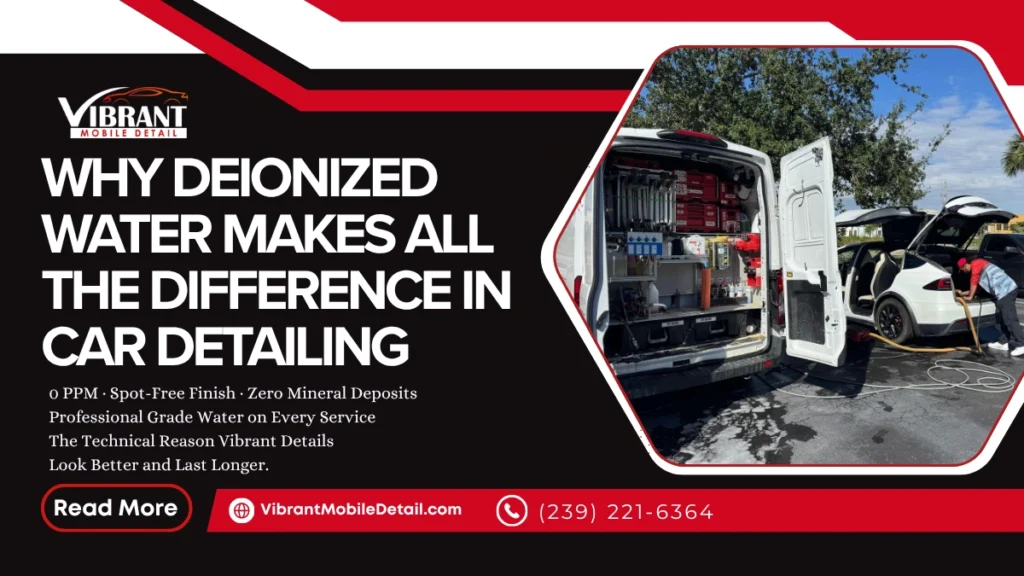
For Vibrant Mobile Detail’s shop and our mobile van setups, this is the general configuration. It gives us consistent 0 ppm water for every service, sustainable resin life, and manageable per-gallon cost. It also gives us the ability to guarantee spot-free finishes regardless of vehicle color, weather conditions, or timing pressure.
How to Test the Difference Yourself
You do not need to take our word for any of this. Here is a test you can run at home for less than $20 that demonstrates exactly what tap water does versus what deionized water does.
What you need:
- Digital TDS meter (available on Amazon for $10 to $20)
- Two spray bottles
- One filled with your tap water
- One filled with distilled water from a grocery store (as a stand-in for DI water since both are near-zero TDS)
- A black or dark-colored car panel that is clean and dry
- A microfiber towel for cleanup afterward
How to run the test:
- Measure the TDS of your tap water. Write it down. For most Florida homes, expect 150 to 400+ ppm.
- Measure the TDS of the distilled water. Should read 0 to 5 ppm.
- In indirect light on a mild day, spray five separate droplet patterns of tap water on one section of the panel. Spray five separate droplet patterns of distilled water on another section, at least a foot away from the tap water samples.
- Leave the panel to air-dry completely. This will take 15 to 30 minutes depending on conditions.
- Once fully dry, inspect both sections under bright light or in direct sun.
The tap water spots will be immediately visible as white or grayish rings. The distilled water spots will be invisible or nearly so. That is the exact same difference between what a low-tier detailer using tap water leaves behind and what a professional operation using DI water leaves behind. Scale that up to a full-vehicle rinse and you understand why the water choice matters.
Bonus test: use the same TDS meter on any water source that claims to be “pure” or “spot free.” Bottled drinking water, filtered fridge water, and even RO water for coffee makers will all read above zero. If the number is not near zero, the water will spot.
Why This Matters for Every Service Level
Water spots are not just a “premium detail” concern. Any wash performed anywhere in Florida with tap water risks spotting. Let me walk through what happens at each service level with tap versus DI water so you can see where the differences show up.
Basic Maintenance Wash
At the Bronze Clean or Silver Shine level, the goal is a clean vehicle with even coverage of any applied protection product. If a detailer uses tap water for the final rinse, the vehicle leaves the appointment with mineral deposits already forming as the water dries. On dark paint, spotting is often visible before the technician has finished putting away the wash tools. The customer picks up a “just detailed” car that has fresh water spots on it.
At Vibrant, both Bronze Clean at $200 and Silver Shine at $240 for a small vehicle use the same DI water on the final rinse as the top-tier ceramic coating install does. There is no water quality upgrade path in our pricing because we do not use tap water on any service.
Complete Interior and Exterior Detail
The Gold Detail package at $340 to $400 depending on vehicle size includes a Complete Interior Detail plus a wash and ceramic spray sealant. The Platinum Detail at $410 to $490 adds paint correction and Meguiar’s Carnauba wax. Both packages require DI water not just for the wash rinse but also for glass cleaning. Interior windows cleaned with mineral-heavy water leave streaks and haze that no amount of buffing eliminates. The mineral film sits on the glass, catches light differently than clean glass, and produces the “streaky” look that customers blame on the technician when the actual cause is the water.
Paint Correction
Before any paint correction work begins, the vehicle needs to be surgically clean. Mineral residue from a tap water rinse interferes with polishing compounds in specific ways. Compounds cut differently through a mineral film versus through clean paint, and the residue can cause uneven correction results, hazing, and inconsistent finish quality. Vehicles that come in for paint correction get an aggressive wash and DI rinse specifically to eliminate any mineral contamination before the correction stage starts.
Ceramic Coating Application
This is where deionized water becomes non-negotiable rather than merely important. Ceramic coating chemistry relies on direct molecular bonding between the coating’s silica structure (SiO2 primarily, sometimes with titanium dioxide or aluminum oxide additions) and the polymer surface of the clear coat. Any contaminant between the two prevents proper bonding.
Mineral deposits from tap water rinses count as contamination. Even microscopic mineral film that is invisible to the eye will interfere with coating bond quality. A ceramic coating installed over mineral-contaminated paint will look great immediately but will fail early. Hydrophobic performance drops within months instead of years. Warranty performance is compromised. The entire investment in the coating gets undercut by a technical detail during prep.
Our Crystal Serum Ultra installs at $1,400 to $2,300 for standard vehicles include multiple DI water rinses through the prep stages. Every wash between decontamination, correction, and final IPA wipedown uses DI water. This is one of several reasons the 9-year warranty from Gtechniq is possible on our installs. Skipping DI water in coating prep is one of the most common corner-cuts we see when we get called to fix failed coatings from other installers.
RV and Boat Detailing
Water spot problems scale with surface area. A car has maybe 100 square feet of painted panels. A 40-foot Class A motorhome has 400 to 500 square feet of gelcoat or painted surface. Every mineral spot on a car is 4 to 5 times worse in aggregate on an RV. This is why our RV mobile detailing service uses DI water on every wash package from the $270 Basic Wash to the $780 Top Package. The visible spotting difference on a fully cleaned RV washed with tap versus DI water is dramatic. RV owners who wash their own rigs in campgrounds using site water are almost always dealing with progressive mineral buildup that shows up as chronic dullness they cannot polish out.
What Cheaper Detailers Actually Do
We compete against a lot of Florida detailers who claim to deliver professional results at prices that would not cover the operational cost of running a real DI water setup. The math is worth spelling out because it explains what customers are actually paying for at each price point.
DI cartridge cost: A commercial mixed-bed DI cartridge suitable for detailing costs roughly $150 to $400 depending on size and quality. It produces spot-free water at 0 ppm until the resin exhausts, at which point it needs to be replaced or regenerated. At Florida water hardness levels, a 400-gallon cartridge might last 200 to 300 gallons before spotting risk returns.
RO membrane cost: A commercial RO system suitable for detailing runs $500 to $2,000+ depending on capacity. Membranes need replacement every 2 to 4 years depending on water quality and use volume, at roughly $200 to $500 per replacement.
Water use per detail: A standard car detail uses 20 to 40 gallons of water for the full multi-stage wash. An RV detail can use 60 to 100 gallons. Ceramic coating prep can use 30 to 50 gallons for pre-wash decontamination.
Cost per gallon of DI water in a professional setup: After amortizing equipment and consumables, professional DI water in a well-run operation costs roughly $0.25 to $0.75 per gallon. For a car detail, that is $10 to $30 in water cost. For an RV, $30 to $75.
When a detailer quotes $80 for a full car detail, the DI water alone would be 15 to 40 percent of the total price. They are not using DI water. They are using tap water from the customer’s outdoor spigot, and the customer’s paint pays the price over time.
This is one reason we recommend asking any Florida detailer directly whether they use deionized water on every service, whether they own their DI system or rely on the customer’s water source, and whether they can produce a TDS meter reading on the day of service. Those three questions expose the difference between operations that invest in professional infrastructure and operations that skip it to protect margin.
When Tap Water Is Actually Fine
To be technically honest, tap water is not universally bad for every stage of a car wash. There are specific stages where tap water is perfectly acceptable in a professional process.
Initial pre-rinse: The first rinse to flush loose contamination off the vehicle can use tap water safely because everything gets soaped, agitated, and rinsed again in later stages. Any mineral deposition at the pre-rinse stage gets washed away before drying can happen.
Foam soak application: Some foam cannons and pre-soak stages use tap water without issue because the surfactants in the foam suspend contamination and get rinsed off.
Wheel and tire cleaning: Wheels and tires are cleaned separately from painted surfaces, often with more aggressive chemicals, and residual mineral deposits on wheels and tires do not cause the same paint damage risk that spots on painted surfaces cause.
Undercarriage rinse: The undercarriage does not have exposed paint the same way body panels do. Mineral residue in wheel wells and on frame components does not cause the visible spotting or etching that painted surface exposure does.
Where tap water is not acceptable, ever, in professional detailing:
- Final rinse of painted surfaces
- Any glass cleaning
- Any surface that will receive ceramic coating
- Any surface that will receive wax or sealant application
- Any interior wiping that uses water as a carrier
- Any RV or boat gelcoat surface
The distinction between where tap water is okay and where it is not comes down to whether the water will evaporate on a finished surface. Anywhere it might be, DI water is the professional choice.
The Advanced Details Most Guides Skip
If you have made it this far, you probably want the technical details that separate genuine expertise from surface knowledge. Here are the advanced points that come up in ceramic coating training and professional detailing certifications.
Resin Regeneration vs Replacement
Ion exchange resin can be regenerated. The process uses concentrated acid (for cation resin) or base (for anion resin) to strip the captured ions off the resin and restore its capacity. Industrial water treatment plants regenerate resin regularly. For detailing operations, regeneration is usually not cost-effective because the concentrated acids and bases are hazardous, the process requires careful pH management, and disposal of the spent regeneration chemicals has environmental considerations. Most professional detailing shops replace rather than regenerate. Some larger operations that use industrial water treatment services can access regenerated resin at lower cost, but this is uncommon.
Temperature Effects on DI Performance
DI resin exchange rates are affected by water temperature. Cold water flows through resin at slower rates and can produce higher effluent TDS if flow rate is not adjusted. Warm water flows faster but resin capacity per gallon can drop. Most professional systems are designed around expected operating temperatures and stay in a workable range. Cold-morning winter details in Florida (December through February) rarely have water cold enough to cause DI performance issues.
Silica in Water
TDS meters measure electrical conductivity as a proxy for dissolved solids. They are excellent at detecting ionic solids like calcium, magnesium, sodium, and chloride. They do not measure dissolved silica accurately because silica is not ionic in water. This matters for ceramic coating prep because dissolved silica is one contaminant that can affect coating bond. Florida water is not typically high in silica, but this is a technical footnote worth knowing if you research water quality further.
The pH Question
Fresh DI water is slightly acidic due to dissolved atmospheric carbon dioxide reacting with the water to form carbonic acid. This is normal and does not affect detailing performance. The pH of DI water in an open system typically stabilizes around 5.5 to 6.5, which is safe for automotive paint and coatings. Sealed DI water can be closer to neutral pH 7, but it will drift acidic once exposed to air.
Why “Spot Free” Rinse Aids Are Not the Same
Some car washes market a “spot free” final rinse that uses a rinse aid additive to modify how water beads and dries. These additives can reduce visible spotting but they do not eliminate mineral deposits. The minerals still land on the paint. The rinse aid just changes the droplet geometry so the spots are less visible immediately. Over months of repeated use, the mineral load still accumulates and causes the same progressive etching that untreated tap water causes. Genuine spot-free rinsing requires DI or distilled water. Rinse aids over tap water are a compromise that trades visible short-term spotting for less-visible long-term contamination.
What This Means for Your Detailer Selection
If you are shopping detailing services anywhere in Florida, water is one of the fastest ways to evaluate technical competence. The questions to ask, and the answers a real professional operation will give:
Do you use deionized water for the final rinse?
Answer: yes, on every service. If the answer is “for premium services only” or “if you want to pay extra,” that is a red flag. Professional detailing operations do not charge water quality as an upsell.
Where does your water come from during mobile service?
Answer: onboard DI water tanks in the mobile van. If the answer is “we hook up to your outdoor spigot,” the water is tap water, and any spot-free claim is not credible.
What TDS reading do you target on the final rinse?
Answer: 0 ppm, verified regularly with an inline TDS meter or handheld tester. If the detailer does not know what a TDS meter is, they are not measuring water quality at any stage.
How often do you replace your DI resin?
Answer: based on gallons through and effluent TDS reading, typically every 2 to 4 weeks in a busy Florida operation. If the answer is vague (“when it seems like it needs it”), the operation is not tracking resin performance.
Does DI water cost extra?
Answer: no, it is included in every service. If DI water is a paid upgrade, that operation views professional water quality as a premium feature rather than a baseline standard.
Any Florida detailer who cannot answer all five questions clearly is not a professional operation in the technical sense of that term. That does not mean they cannot produce a decent wash. It means they cannot produce professional-grade detailing where the results hold up to Florida’s climate long-term.
The Bottom Line
Deionized water is not the flashiest topic in car detailing. It does not show up in package names, marketing photos, or before-and-after Instagram posts. But it is one of the technical foundations that determines whether a professional detail actually holds up in Florida conditions or falls apart within weeks.
Every wash performed with tap water in Florida progressively damages your paint through mineral etching. Every ceramic coating installed over paint that was rinsed with tap water during prep will fail earlier than it should. Every “spot free” claim from a detailer who uses tap water is technically incorrect regardless of what rinse aid they add downstream.
Every service Vibrant Mobile Detail performs, whether at your location or at our Fort Myers shop, uses deionized water measured to 0 ppm on the final rinse. This is not a premium upsell. This is the technical baseline for any detailing service that is going to hold up to Florida’s climate.
Frequently Asked Questions
What is deionized water in car detailing?
Deionized water is water that has been processed through ion exchange resin to remove all dissolved mineral ions like calcium (Ca2+), magnesium (Mg2+), sulfate, and chloride. It reads 0 ppm on a total dissolved solids meter and evaporates cleanly without leaving mineral deposits on paint. Professional detailers use it for final rinses to eliminate water spots, and for prep work on ceramic coating installations where coating bond quality depends on a chemically clean surface.
How is deionized water different from distilled water?
Both produce very pure water but through different processes. Distilled water is made by boiling water and condensing the steam, leaving minerals in the boiling chamber. It typically reads under 5 ppm. Deionized water is made by ion exchange resin that traps mineral ions, replacing them with hydrogen and hydroxide ions that recombine into water. Fresh DI water reads 0 to 1 ppm. For practical use in car detailing at scale, DI is more cost-effective than distilled. For occasional home use on a small application, distilled water works fine.
How does deionized water compare to reverse osmosis water?
Reverse osmosis removes 90 to 99 percent of dissolved solids, producing water in the 10 to 40 ppm range from Florida tap water. Deionization takes water down to 0 ppm. RO alone is not spot-free on hot Florida paint. Most professional operations use RO feeding into DI, which combines RO’s high-volume treatment capacity with DI’s zero-TDS finishing. This is the standard setup at Vibrant Mobile Detail.
Do all professional detailers use deionized water?
No, and this is one of the biggest technical quality gaps in the detailing industry. Professional operations that invest in proper equipment use DI water on every service. Budget operations, quick washes, and low-tier mobile detailers often use tap water because the equipment costs money to operate. Asking whether the detailer uses DI water on every service, and whether they can verify it with a TDS meter, is the fastest way to separate professional operations from budget ones.
How hard is Florida water compared to other states?
Very hard. Municipal water across Florida runs from 129 ppm in Orlando to 317 ppm in West Palm Beach, with Fort Myers and Naples in the 200 to 250 ppm range typical for Southwest Florida. The national median for municipal water is closer to 100 ppm. Florida’s water hardness is driven by the Floridan Aquifer, which is one of the largest limestone-based aquifers in North America. Every gallon of Florida tap water carries dissolved calcium and magnesium picked up as the water flows through millions of years of limestone deposits.
Can I use deionized water to wash my car at home?
Yes, and it is worth considering if you wash your own vehicle regularly. Home DI water systems designed for driveway car washing are available in the $200 to $800 range. Combining DI water with the two-bucket wash method gives you close to professional-grade results at home. For ceramic-coated vehicle owners who maintain their vehicles between professional inspections, home DI water is close to essential because tap water rinses accelerate coating degradation.
Why does deionized water matter for ceramic coating?
Ceramic coating bonds chemically with the paint surface. Any contamination between the coating and the paint, including microscopic mineral residue from a tap water rinse, prevents proper bonding. A coating installed over mineral-contaminated paint looks great immediately but fails early, losing hydrophobic performance within months instead of the multi-year performance you paid for. Every ceramic coating install should include DI water on every prep wash. If the installer does not use DI water throughout coating prep, the warranty performance of the coating is compromised regardless of how good the product itself is.
Do water spots damage my paint or are they just cosmetic?
Both. The visible white spot on the surface is mineral deposit that can usually be removed with a targeted cleaning. The underlying damage happens when the mineral deposits are alkaline and Florida heat accelerates a hydrolysis reaction that etches the clear coat below the mineral spot. That etching becomes permanent below-surface damage that requires paint correction to remove. A single water spot rinsed off within hours is essentially harmless. Water spots that sit on Florida paint for days progress from cosmetic to permanent surprisingly fast.
What is a TDS meter and should I own one?
A TDS meter is a small handheld device that measures total dissolved solids in water by electrical conductivity, displayed in parts per million. They cost $10 to $20 on Amazon and are worth owning if you care about water quality for any purpose. You can measure your tap water hardness (compare to the Florida city data above), test filtered water sources, verify that any DI or distilled water you use is actually reading near zero, and check whether commercial “spot free” rinse claims are legitimate.
Do Vibrant Mobile Detail vans carry their own deionized water?
Yes. Every Vibrant Mobile Detail mobile van carries onboard DI water tanks and pumps. We bring pure water directly to your location whether you are in Fort Myers, Cape Coral, Naples, Bonita Springs, Estero, or any other community in our current Southwest Florida service area. You do not need to provide water access, and our water is tested regularly with a TDS meter to confirm 0 ppm on the final rinse. This is standard for every service we perform, from the $200 Bronze Clean maintenance package to the $2,300 Platinum Ceramic Coating install.
What if I have well water at home, is it different?
Yes, often significantly worse than municipal water. Well water in Southwest Florida frequently runs 400 to 800+ ppm depending on well depth and aquifer conditions. If you wash a vehicle at a rural home with well water, mineral spotting risk is even higher than with city water. Some rural properties also have iron in the well water, which produces orange-brown mineral deposits that can permanently stain paint. If you live on well water and wash vehicles at home, a home water softener plus DI polishing stage is the technically correct setup, or bring the vehicle to us for professional detailing.
Can I use deionized water in my car battery or windshield washer fluid?
Deionized water is the correct choice for lead-acid car batteries if you have a battery that requires topping off with water. Mineral deposits from tap water interfere with battery chemistry and reduce battery life. For windshield washer fluid, DI water works fine as the water component of a homemade washer fluid mix, but do not use pure DI water in the washer fluid reservoir without additives because it will freeze in cold weather and does not contain the cleaning agents that commercial washer fluids provide.
Ready to Book a Detail That Actually Uses Deionized Water
If you want a professional detail that finishes truly spot-free, book a service with Vibrant Mobile Detail. Our current mobile service area covers Fort Myers, Cape Coral, Naples, Bonita Springs, Estero, and communities across the Southwest Florida corridor from Punta Gorda to Marco Island. Shop drop-off at our Fort Myers facility saves you 15 percent and is available to owners from anywhere in Florida who want ceramic coating or Superior detailing performed in our climate-controlled bays. Call us at (239) 221-6364 to talk through what package fits your vehicle and situation.