
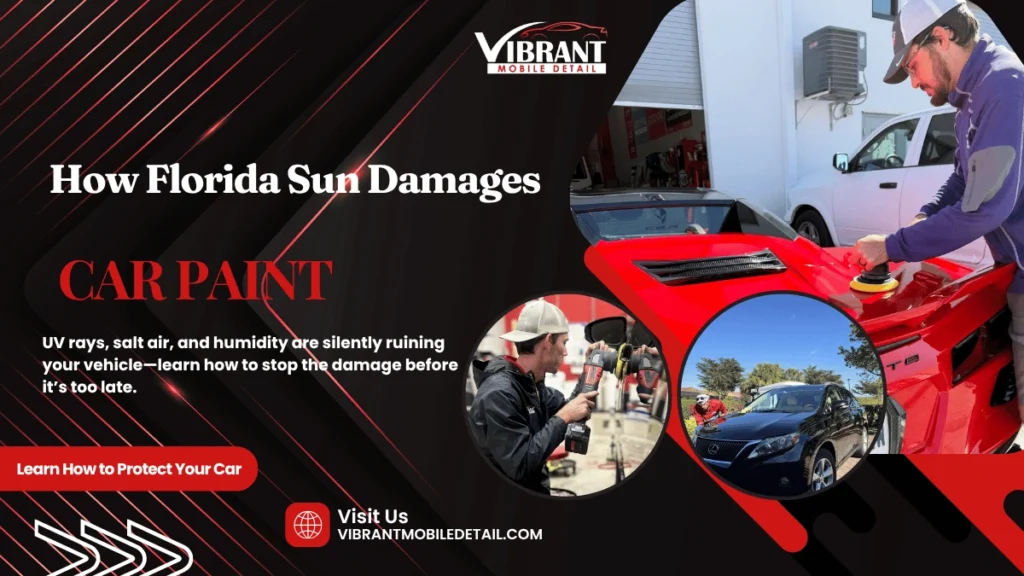
Florida sun damage to car paint is not a matter of if. It is a matter of when. The Sunshine State delivers some of the most punishing UV radiation in the entire country, and when you combine that with salt-saturated coastal air and humidity that rarely drops below 70%, you get a three-pronged attack that can turn a glossy showroom finish into a faded, chalky mess in under a year.
If you drive anywhere in Southwest Florida, whether that is Fort Myers, Naples, Cape Coral, Bonita Springs, Estero, or Marco Island, your vehicle is exposed to this damage every single day. The hood, roof, and trunk take the worst beating from direct sunlight, but salt air attacks every surface, door jambs, and trim that most owners forget about entirely.
This guide breaks down exactly how each environmental factor destroys your paint, what the visible warning signs look like at each stage, and the most effective protection methods ranked by cost, durability, and real-world performance in Florida’s climate.
Why Florida Ranks Among the Worst States for Car Paint
Florida is not just sunny. It is aggressively sunny. The state sits between 24° and 31° latitude, putting it closer to the equator than any other part of the continental U.S. That geographic position means UV radiation hits harder and more consistently throughout the year.
The average UV Index in South Florida regularly exceeds 10 during summer months, a level the EPA classifies as “very high” to “extreme.” Fort Myers and Naples frequently record UV Index readings of 11 or 12 between May and September. Compare that to a state like Michigan, where the UV Index rarely exceeds 7 even at peak summer.
But UV is only part of the problem. Southwest Florida sits directly on the Gulf Coast, where warm, salt-laden air drifts inland for miles. Add average relative humidity between 74% and 90% depending on the season, and you have a climate that accelerates every form of paint degradation at once.
Coastal vehicles in SWFL can show visible paint damage up to three times faster than identical vehicles parked inland. If you have ever wondered why car paint fades in Florida so much faster than in northern states, the answer is this combination of geography, proximity to saltwater, and relentless moisture. A car left unprotected outdoors in Fort Myers will typically show noticeable fading, water spotting, or clear coat haze within 6 to 12 months.
UV Rays: The Silent Clear Coat Killer
Ultraviolet radiation is the single biggest threat to automotive paint in Florida. It works quietly, consistently, and its damage is cumulative. Every hour of sun exposure adds to the total degradation, even when you cannot see it yet.
How UV Breaks Down Your Clear Coat
Your vehicle’s finish is a layered system. The metal body sits under a primer layer, then a base coat (the actual color), and finally a clear coat, which is a transparent protective layer that provides gloss and shields the pigment underneath.
UV photons carry enough energy to break the chemical bonds that hold the clear coat together. This process, called photodegradation, weakens the molecular structure of the clear coat over time. As those bonds break, the once-smooth surface becomes rough, porous, and increasingly brittle.
The progression follows a predictable pattern. First, the clear coat loses its optical clarity and develops a subtle haze. Then it becomes chalky to the touch. That powdery white residue comes off when you run a finger across the surface. Eventually, the weakened clear coat cracks, peels, and separates from the base paint entirely. This is the full arc of UV damage to clear coat oxidation: from invisible chemical breakdown to total failure of the protective layer.
Thermal Stress Compounds UV Damage
Florida surface temperatures on a dark-colored car can exceed 150°F on a summer afternoon. That extreme heat causes the paint layers to expand and contract at different rates. Over hundreds of heating and cooling cycles, micro-cracks form in the clear coat. They are invisible to the naked eye at first, but devastating because they allow moisture, salt, and pollutants to penetrate deeper into the paint system.
These thermal cracks are why damage accelerates so rapidly after the first year. Once the clear coat barrier is compromised, the base paint is exposed, and fading can happen within weeks rather than months.
Colors That Fade Fastest in Florida
Not all paint colors degrade at the same rate under UV exposure. Darker pigments absorb more solar energy, which means they experience greater thermal stress and faster photodegradation.
| Paint Color | UV Vulnerability | Typical First Signs | Time to Visible Fading (Unprotected) |
| Red | Very High | Pink shift, chalking | 4-8 months |
| Black | Very High | Gray haze, swirl visibility | 6-10 months |
| Dark Blue | High | Purple shift, dullness | 6-12 months |
| Dark Green | High | Yellowing, matte patches | 8-12 months |
| Silver/Gray | Moderate | Water spot etching, haze | 10-14 months |
| White | Lower (but not immune) | Yellowing, oxidation rings | 12-18 months |
| Pearl/Metallic | Moderate | Flake discoloration, dullness | 8-14 months |
Red is the most vulnerable because the pigment molecules that produce red wavelengths have weaker chemical bonds. Black absorbs the most heat, compounding thermal stress on top of UV damage. White lasts longest because it reflects more UV radiation, but it still oxidizes. It just takes longer.
Salt Air: The Invisible Corrosive Eating Your Paint
Even if your car never touches a beach, living anywhere near the Gulf Coast means your vehicle is being dusted with microscopic sodium chloride particles every single day. Salt air carries these crystals miles inland, and in a humid environment like Southwest Florida, they do not just sit on the surface. They dissolve into an active corrosive film.
The Electrochemical Attack
When salt particles land on your car and absorb moisture from the humid air, they form a thin electrolyte layer. This electrolyte enables electrochemical corrosion. Think of it as a tiny battery forming on the surface of your paint, where electrons flow between the metal and the salt solution and eat away at the material.
This reaction targets the clear coat first, creating microscopic pits that are invisible to the eye but compromise the protective layer. Once the pits break through to the base paint or the metal underneath, rust begins forming almost immediately.
Where Salt Does the Most Damage
Salt does not attack evenly. It accumulates in crevices and seams where it is hardest to rinse away. The most vulnerable areas on any vehicle include door jambs, trunk seams, hood edges, wheel wells, the undercarriage, and any spot where trim meets body panels.
For drivers in Cape Coral, Fort Myers Beach, Sanibel, and Marco Island, all surrounded by saltwater canals and Gulf breezes, salt air corrosion on coastal cars is significantly worse than vehicles parked even 15 miles further inland. Catching this kind of exterior damage from salt exposure early is the key to avoiding expensive repaints later.
Salt and Swirl Marks: A Hidden Connection
Salt crystals are not smooth. They have jagged, abrasive edges. When an owner wipes down a salty car with a dry towel or runs it through a basic drive-through car wash without proper pre-rinsing, those crystals act like sandpaper. The result is thousands of micro-scratches, commonly called swirl marks, that dull the finish and create additional entry points for moisture and further corrosion.
This is one of the most common mistakes SWFL car owners make. A quick wipe-down after a trip to Fort Myers Beach feels productive, but without a thorough water rinse first, it does more harm than good.
Humidity: The Damage Multiplier
If UV rays are the hammer and salt air is the chisel, Florida’s humidity is the hand that never stops swinging. Moisture in the air does not cause paint damage by itself, but it amplifies everything else.
How Humidity Accelerates Oxidation
Oxidation is the chemical reaction where oxygen bonds with the paint molecules. It happens faster in the presence of moisture. Florida’s average relative humidity hovers around 74% year-round, but during summer months it frequently spikes above 90% in the mornings.
That persistent moisture keeps the salt on your car activated and corrosive for longer. Instead of drying out and becoming inert, salt deposits stay wet, acidic, and aggressive throughout the day and night. The result is a corrosion cycle that essentially never pauses.
Water Spots and Acid Etching
High humidity increases the frequency and severity of water spotting. When moisture lands on your vehicle, whether from morning dew, afternoon thunderstorms, or lawn sprinklers, it carries dissolved minerals and pollutants. As the water evaporates in the Florida heat, those minerals concentrate and bake into the clear coat.
These are not cosmetic blemishes that wipe off easily. Mineral deposits from hard water (which is common throughout Lee and Collier County) etch into the clear coat, creating permanent rings that can only be removed through professional car paint correction.
The Contaminant Trap
Humid air makes surfaces tacky. Bird droppings, tree sap, pollen, industrial fallout, and the notorious Florida love bug splatter all bond to the paint faster and adhere more stubbornly in humid conditions. These organic contaminants are acidic. Left on the surface for even 24 to 48 hours in the Florida heat, they etch through the clear coat and stain the base paint permanently. Humidity paint damage prevention starts with understanding this sticky reality. Act before contaminants have time to bond.
Love bugs are a seasonal menace across all of SWFL, typically swarming in May and September. Their body chemistry is so acidic that splatter left on a hood for more than a day in direct sun can etch through even a waxed surface.
The Vicious Cycle: How All Three Forces Work Together
The real danger is not any single element. It is how they combine and reinforce each other in a continuous loop.
UV radiation weakens the clear coat. Salt deposits settle into those weakened areas and begin corroding. Humidity keeps the salt active and prevents drying. Heat from the sun accelerates every chemical reaction. The weakened clear coat develops micro-cracks. Moisture seeps through those cracks, reaching the base paint and eventually the metal underneath. Rust starts forming beneath the surface, pushing up as bubbles or blisters in the paint.
This cycle accelerates over time. A vehicle that looks fine after six months in Florida can deteriorate rapidly between months 8 and 14 as the initial clear coat damage reaches a tipping point. Once the cycle gains momentum, stopping it requires professional intervention, not just a wash and wax. Understanding how sun damage to car paint in Florida compounds over time is the difference between catching it early and dealing with a total failure.
The Florida Paint Damage Timeline
| Time Exposed (Unprotected) | Typical Visible Damage | Reversibility |
| 0-3 months | Minor haze, light water spots | Fully reversible with wash + wax |
| 3-6 months | Noticeable dullness, embedded water spots | Reversible with clay bar + sealant |
| 6-12 months | Fading on hood/roof, swirl marks, salt residue in crevices | Requires machine polishing |
| 12-18 months | Chalking, clear coat peeling on edges, micro-rust | Requires paint correction |
| 18-24 months | Significant fading, bubbling, rust formation | Partial respray may be needed |
| 24+ months | Widespread clear coat failure, deep rust, structural corrosion | Full repaint ($3,000-$7,000+) |
The cost of ignoring paint protection in Florida is not hypothetical. A full professional repaint on a sedan runs $3,000 to $5,000. For an SUV, truck, or luxury vehicle, that number can easily hit $7,000 to $10,000 or more. Owners who invest in preventive protection spend a fraction of that cost and maintain higher resale values.
How Florida Paint Damage Destroys Resale Value
The financial impact extends beyond the cost of repair. A vehicle with visible paint damage, whether fading, oxidation, peeling clear coat, or rust, loses significant resale value. This is why car paint fade in Florida is not just a cosmetic nuisance. It is a depreciating asset problem. Dealerships, private buyers, and trade-in evaluators all factor exterior condition heavily into their pricing.
A well-maintained exterior in Florida can preserve $2,000 to $5,000 in resale value over a 5-year ownership period compared to an unprotected vehicle of the same make, model, and mileage. For luxury vehicles, the gap widens even further.
Protecting your paint is not just an aesthetic choice. It is a financial decision that pays for itself when you sell or trade in.
Proven Protection Methods Ranked for Florida’s Climate
Not all protection is created equal. Here is how the most common methods stack up against Florida’s specific combination of UV, salt, and humidity, ranked by effectiveness, durability, and cost.
Comparison: Paint Protection Methods for Florida
| Protection Method | UV Resistance | Salt/Corrosion Resistance | Humidity/Water Resistance | Durability | Approx. Cost | Best For |
| Basic Car Wash Only | None | None (temporary removal) | None | N/A | $10-$30/wash | Maintenance between protection applications |
| Spray Wax | Low | Low | Low | 2-4 weeks | $10-$25 DIY | Quick shine between proper treatments |
| Traditional Carnauba Wax | Moderate | Moderate | Moderate | 4-8 weeks | $20-$80 DIY / $75-$150 pro | Budget-conscious owners |
| Synthetic Paint Sealant | High | High | High | 3-6 months | $30-$60 DIY / $100-$250 pro | Moderate protection on a budget |
| Ceramic Coating (Professional) | Very High | Very High | Very High (hydrophobic) | 5-9+ years with maintenance | $500-$2,000+ pro | Best long-term value for Florida drivers |
Why Ceramic Coating Is the Standard for Florida Vehicles
For drivers in Fort Myers, Naples, and across SWFL, professional car ceramic coating has become the baseline protection. It is no longer considered a luxury upgrade.
A ceramic coating is a liquid polymer that chemically bonds to the factory clear coat, creating a semi-permanent nano-layer of protection. This layer provides three critical benefits that directly counter Florida’s environmental threats. First, it blocks UV radiation from reaching the clear coat, dramatically slowing oxidation and fading. Second, its hydrophobic surface repels water, preventing mineral deposits from bonding and reducing water spot formation. Third, it resists chemical corrosion from salt, making it far harder for salt air to initiate the electrochemical reactions that lead to rust.
At Vibrant Mobile Detail, we apply Crystal Serum Ultra by Gtechniq. It is the top-tier professional coating on the market and carries a 9-year warranty with proper maintenance. Applications are done at our climate-controlled shop at 8801 Business Park Dr in Fort Myers to ensure optimal curing conditions. The company has been protecting vehicles across Florida since 2013, and founder Tanner Reid built the business specifically around the unique demands of the SWFL climate. For a full breakdown of how these coatings work and what to expect, read our ultimate guide to ceramic coating.
Wax and Sealant: Good for Maintenance, Not Enough Alone
Traditional wax and synthetic sealants provide legitimate UV and moisture barriers, but in Florida’s climate they degrade too quickly to serve as standalone protection. Carnauba wax lasts 4 to 8 weeks before the Florida sun breaks it down. Synthetic sealants push that to 3 to 6 months.
These products work best as maintenance layers between professional ceramic coating applications, or for owners who detail their vehicles frequently. Even a basic bronze clean on a regular schedule removes the salt and contaminants that accelerate breakdown. They are not a substitute for long-term protection in a coastal environment.
The Florida Car Owner’s Seasonal Protection Calendar
Consistent maintenance is what keeps paint damage from getting ahead of you. Here is a practical seasonal schedule built specifically for SWFL vehicle owners.
| Season / Month | Priority Actions | Why It Matters |
| Jan – Feb (Dry Season) | Full wash + clay bar; apply sealant if not ceramic coated; wash every 2 weeks | Winter visitors increase road traffic and debris; pollen season begins; humidity starts rising |
| Mar – Apr (Pre-Summer) | Weekly washes; inspect paint condition; schedule ceramic coating if due | UV intensity ramps up fast; UV Index exceeds 9 by April; salt air intensifies with onshore breezes |
| May (Love Bug Season 1) | Weekly wash; remove love bugs within 24 hours; bird dropping removal immediately | Love bug season peaks; UV at extreme levels; acidic splatter etches through wax quickly |
| Jun – Aug (Peak Season) | Weekly wash minimum; rinse after storms; shade parking when possible | Peak UV, humidity, and heat. This is the fastest damage period of the year |
| Sept (Love Bug Season 2) | Weekly wash; second love bug season; full decontamination wash | Love bugs return; hurricane season debris and salt spray increase contamination |
| Oct – Nov (Post-Summer) | Wash every 2 weeks; inspect undercarriage for salt buildup; paint correction if needed | Humidity tapers; ideal time for ceramic coating application and assessing post-summer damage |
| Dec (Dry Season Returns) | Wash every 2 weeks; clean door jambs and trunk seams thoroughly | Cooler temps make this a great window for professional exterior detailing before the new year |
Owners with boats and RVs face the same environmental threats at an even larger scale. Salt exposure on marine vessels is constant, making regular boat detailing essential for preventing oxidation from taking hold. Fiberglass hulls suffer from gelcoat restoration issues that mirror clear coat failure on cars, and boat maintenance programs keep that cycle from starting. On the RV side, RV mobile detailing addresses the massive surface areas that bake in outdoor storage, while boat ceramic coating and RV ceramic coating follow the same protective principles, just applied to larger surfaces and different gel coat or paint systems.
Professional vs. DIY Protection: What Actually Works in Florida
The DIY detailing market is massive, and there is no shortage of products claiming ceramic-level protection in a spray bottle. Here is the honest comparison for Florida conditions.
| Factor | DIY (Consumer Products) | Professional Application |
| Surface Prep | Hand wash + limited decontamination | Machine polish, clay bar, chemical decontamination, paint correction |
| Coating Grade | Consumer-grade SiO2 (lower concentration) | Professional 10H ceramic with Crystal Serum Ultra (higher concentration, harder cure) |
| Durability in Florida | 3-6 months (often less with salt exposure) | 5-9+ years with Crystal Serum Ultra and proper maintenance |
| UV Protection | Moderate | High to Very High |
| Hydrophobic Performance | Good initially, degrades fast | Excellent, maintains performance for years |
| Application Environment | Outdoor/garage (dust, humidity interference) | Climate-controlled bay (optimal curing conditions) |
| Total Cost (3-year period) | $150-$400+ (repeated purchases and reapplication) | $500-$2,000 (one-time application, warranty included) |
| Warranty | None | Included with professional application |
In a mild climate, consumer-grade products can hold up reasonably well. In Florida’s triple-threat environment, professional coatings applied in a controlled shop setting deliver dramatically better results per dollar over time. The initial investment is higher, but the total cost of ownership over three to five years is often lower than repeatedly purchasing and applying DIY alternatives.
Owners who want the convenience of mobile service for regular maintenance washes and quick details can combine that with shop-based ceramic coating. Mobile car detailing in Fort Myers handles the routine upkeep at your home or office, while the Vibrant Mobile Detail shop handles the heavy-duty protection work in a controlled environment.
Warning Signs Your Paint Is Already Damaged
Catching paint damage early is the difference between a $200 to $600 paint correction and a $5,000 respray. Here are the progressive warning signs every Florida vehicle owner should check for monthly.
Stage 1: Surface Contamination (Reversible): The paint feels rough even after washing. You can see tiny orange or brown specks (iron fallout from brake dust and rail dust) embedded in the surface. Water no longer beads cleanly. The interior often suffers at the same time. Sun-baked dashboards crack and seats fade, making a complete interior detail part of the recovery. This stage is fully fixable with a clay bar treatment and sealant on the exterior.
Stage 2: Oxidation and Haze (Correctable): The finish looks dull in direct sunlight, particularly on the hood, roof, and trunk. Colors appear muted compared to the lower body panels that get less direct exposure. You may notice light swirl marks becoming more visible. A professional machine polish and sealant or ceramic coating reverses this.
Stage 3: Clear Coat Failure (Requires Correction): White, chalky patches appear on horizontal surfaces. The paint feels powdery in spots. You can see a visible line where the clear coat is intact versus where it has worn away. At this point, professional paint correction may be able to restore the finish. When the clear coat has fully failed, it can be too far gone to save without a respray. The sooner it is addressed, the better the outcome.
Stage 4: Deep Damage (Partial Repaint Likely): The clear coat is peeling in sheets. Rust bubbles are forming under the paint. Color has shifted significantly (red turned pink, black turned gray). At this stage, sections of the vehicle will need to be stripped and repainted. Costs escalate rapidly.
Fleet managers operating multiple vehicles across SWFL face these same degradation stages at scale. Commercial vehicles spend more hours exposed to sun and salt, making a proactive protection plan through fleet detailing services essential for maintaining appearance and value across the entire lineup.
SWFL-Specific Threats Most Guides Ignore
Generic paint protection advice does not account for conditions unique to Southwest Florida. Here are the region-specific factors that separate a good protection plan from one that actually works here.
Love Bug Season
Florida love bugs swarm twice a year. The first wave runs late April through May, and the second comes late August through September. Their body fluid is highly acidic (pH around 6.5 when fresh, dropping lower as it decomposes). In SWFL, driving on I-75 or Alligator Alley during peak swarm season can coat a front end in minutes.
Left on the paint for more than 24 hours in direct sun, love bug residue etches through wax, sealant, and even weakened clear coat. The acidity intensifies as the organic material breaks down, so the damage gets worse with every passing hour. Immediate removal with a dedicated bug remover and soft microfiber towel is critical.
Hard Water and Sprinkler Overspray
Lee County and Collier County water is notoriously hard, with high levels of calcium and magnesium. Lawn sprinklers that hit parked vehicles leave mineral-heavy water droplets that bake into the paint. Over time, these create permanent water spot rings that cannot be washed off and require machine polishing to remove.
If your vehicle is regularly exposed to sprinkler overspray, a strong ceramic coating with superior hydrophobic properties is the best defense. The water beads and rolls off before it can evaporate and leave deposits behind.
Construction Dust and Road Debris
SWFL is one of the fastest-growing metro areas in the country. Construction activity along US-41, Colonial Boulevard, and throughout Cape Coral means heavy equipment, loose gravel, concrete dust, and paint-damaging debris on the roads daily. Vehicles driven through active construction zones accumulate abrasive particles that settle into the paint and cause scratching during washes if not rinsed properly first.
Drivers in Cape Coral deal with this on nearly every commute, making regular rinses and a strong protective coating non-negotiable.
Hurricane Season Aftermath
Even if your vehicle survives a storm without physical damage, the aftermath introduces a surge of airborne salt, sand, and debris. Storm surge carries concentrated saltwater miles inland, and the windblown sand acts as an abrasive. Post-hurricane, a thorough wash and inspection should be treated as urgent, not optional. Vehicles stored outdoors during storms often need boat oxidation removal on exposed surfaces after extended salt exposure.
Frequently Asked Questions
How fast does Florida sun damage car paint?
Unprotected vehicles in SWFL typically show visible fading and clear coat haze within 6 to 12 months of daily outdoor exposure. Dark colors like red and black can show signs as early as 4 months. The damage is cumulative. Every day of unprotected sun exposure adds to the total degradation.
Does salt air damage cars even if I do not live on the beach?
Yes. Airborne salt particles travel well beyond the coastline. Vehicles parked in Fort Myers, Cape Coral, and Bonita Springs are all several miles from the Gulf, yet they still accumulate measurable salt deposits, especially when onshore breezes are strong. Regular washing is essential regardless of exact distance from the coast.
What is the single best protection for car paint in Florida?
Professional ceramic coating offers the strongest combination of UV blocking, salt corrosion resistance, and hydrophobic water repellency in a single product. At Vibrant Mobile Detail, we use Crystal Serum Ultra by Gtechniq, which carries a 9-year warranty and is applied in our climate-controlled Fort Myers shop for the best possible cure. It is the most effective long-term investment you can make for a vehicle driven in the SWFL climate.
How often should I wash my car in Southwest Florida?
Every 1 to 2 weeks is the baseline recommendation. During peak summer (June through September) and love bug seasons (May, September), weekly washing is strongly advised. After any coastal trip, beach day, or storm, rinse the vehicle as soon as possible.
Can sun-damaged paint be restored without repainting?
If the clear coat is still partially intact, professional paint correction using machine polishing can remove oxidation, haze, and light etching. Severe cases where the clear coat has fully peeled or rust has formed beneath the surface typically require partial or full repainting.
Does parking in a garage fully protect my car from Florida damage?
A garage eliminates direct UV exposure and reduces salt accumulation significantly, but it does not stop humidity, airborne contaminants, or the damage done during every trip outside. Garage-kept vehicles still benefit from ceramic coating and regular maintenance. They just experience slower degradation.
Are boats and RVs affected the same way?
Yes, and often worse due to larger exposed surface areas and more direct water contact. Boats face constant saltwater exposure, and RVs parked in outdoor storage bake in the sun for extended periods. Fiberglass RVs are especially prone to gel coat breakdown when oxidation sets in. Without regular detailing and protective coatings, these vehicles will need oxidation removal or paint correction to restore the surface. Protective coatings and consistent maintenance are what keep that from happening.
How much does it cost to repaint a car with severe Florida sun damage?
A quality full-vehicle respray typically costs $3,000 to $5,000 for a standard sedan and $5,000 to $10,000+ for SUVs, trucks, and luxury vehicles. Factory-matched paint on exotic cars can exceed $15,000. Proactive protection through ceramic coating costs a fraction of these figures and preserves the original factory finish.
Stop the Damage Before It Starts
Florida sun damage to car paint is aggressive, relentless, and expensive to fix after the fact. But it is entirely preventable with the right protection applied before the damage reaches a critical point.
The owners who keep their vehicles looking sharp in SWFL are not lucky. They are prepared. They wash consistently, protect proactively, and address problems early instead of waiting until they need a full respray.
Whether you need a platinum-tier mobile detail at your driveway, a gold detail to maintain your coating, or a full ceramic coating application at our Fort Myers shop, the investment pays for itself in preserved appearance, lower repair costs, and stronger resale value.
Ready to protect your vehicle? Book your detail today and stop Florida’s climate from winning.